Mitsubishi Mini-Split Comfort App Roll-Out a Disaster

This post may not be of interest to most my followers, but I hope it will be helpful to other Mitsubishi mini-split owners who use the Kumo Cloud App with WiFi to control their heat pumps.

Yesterday all six of my heat pumps began disconnecting from my WiFi and I have not been able to communicate with them until about 9:30 AM this morning. The details are strange and suggest to me that Mitsubishi has pushed some firmware update to these six devices that prevented them from connecting to my WiFi until mid-morning. As of this moment they seem to have restored their network connection — but there is no communication from Mitsubishi that explains what is going on.

What follows are more details of my experience. If you don’t own Mitsubishi mini-splits or use Kumo Cloud you probably won’t be interested in reading on.

I have six Mitsubishi mini-split heat pumps that are all connected to my network with WiFi adaptors that communicate using the Kumo Cloud App. Apparently Mitsubishi is in the process of rolling out a new app to replace Kumo Cloud. They call it Comfort by Mitsubishi Electric. If you go to the Apple App store and try to download Kumo Cloud you will get this new app, instead.

I have updated to the new app on my ipad, but on my iphone I did not update so that I still have the original Kumo Cloud App.

My Home Assistant program actually uses a Kumo Cloud integration to control/monitor my heat pumps over my local area network — uses the ip addresses and Kumo protocol to communicate with them without going out to the cloud. So even when my ISP is down and I have no internet connection, Home Assistant is still able to communicate with my six heat pumps — though the cloud apps on my ipad and phone do not have communication.

Yesterday Home Assistant lost its connection to all six of my heat pumps. I re-loaded HA, I rebooted HA, I updated HA, I rebooted the heat pumps — nothing fixed my connection. My Kumo Cloud app suggested all HP were off-line. I updated the App on my ipad to the new Comfort App, and after some time (a few minutes) it reported the HP as being disconnected from the network.

All six heat pumps have been assigned static ip addresses. I tried pinging them and they would not respond. Other devices on my network continued to work properly.

I rebooted my Deco X-20 access points. I rebooted my pfSense router. Nothing I did could get these six heat pumps to connect to my network. I spent about 3 hours this morning messing with all this.

Then, about 9:30 AM, the heat pumps began to connect to my new Comfort App. Several of them could be controlled with the new App. Others showed up, but the App said they were “off.” I see no way in the App to turn them “on.” I don’t know what off means — but the app is giving me no control of them.

I found that I could ping all six of the heat pumps again. I re-loaded my HA Kumo Cloud integration and all six heat pumps re-connected to HA. I can control them and read their parameters and HA seems to be re-connected as it should be.

But the Comfort App still shows two of the heat pumps as “off”.

And, I am not home free yet. The heat pumps are still disconnecting and re-connecting to my network. Mostly they are connected, but every now and again when I check, one or more is disconnected.

I don’t know what is going on, but this roll-out by Mitsubishi is a disaster. Their Comfort App sucks. Whatever changes they have made to their WiFi boards has bugs — and there seems to be no information provided to consumers to explain what is going on.

Coincidently, my heat pump installer (Dave’s Appliance) had a crew next door working on my neighbor’s heat pump. I stopped over and asked the service tech if he could explain what was going on with the WiFi communication. He said they are getting lots of complaints from customers but no explanation from Mitsubishi. Mitsubishi tells them that there will be erratic behavior for the next couple of months.

This is simply unacceptable.
Follow up to Preliminary Result – electric power data

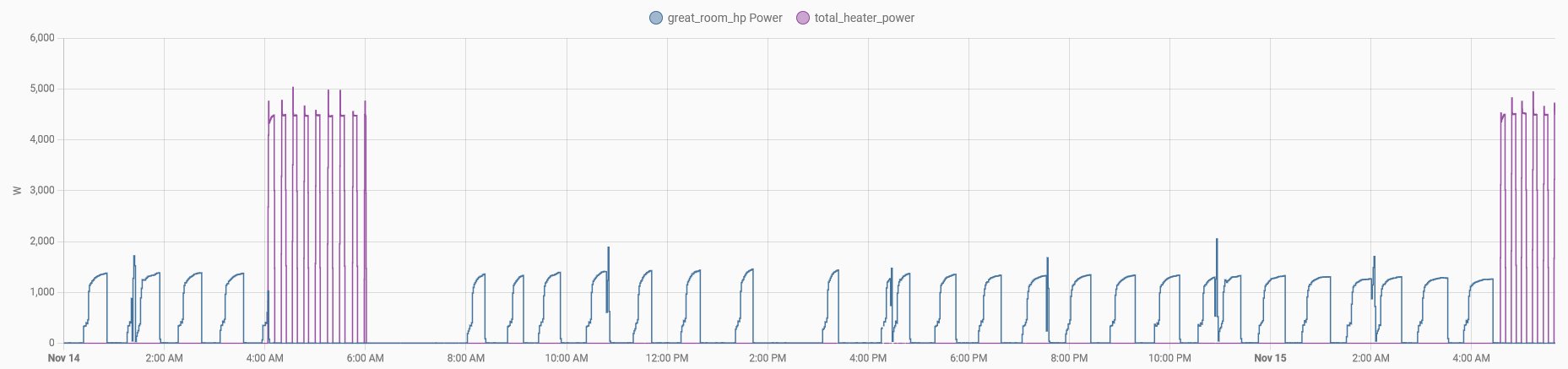
Nate Adams asked whether the heat pump was modulating its electric use to maintain temperature or cycling on and off? The power data (below) show it is cycling on and off.

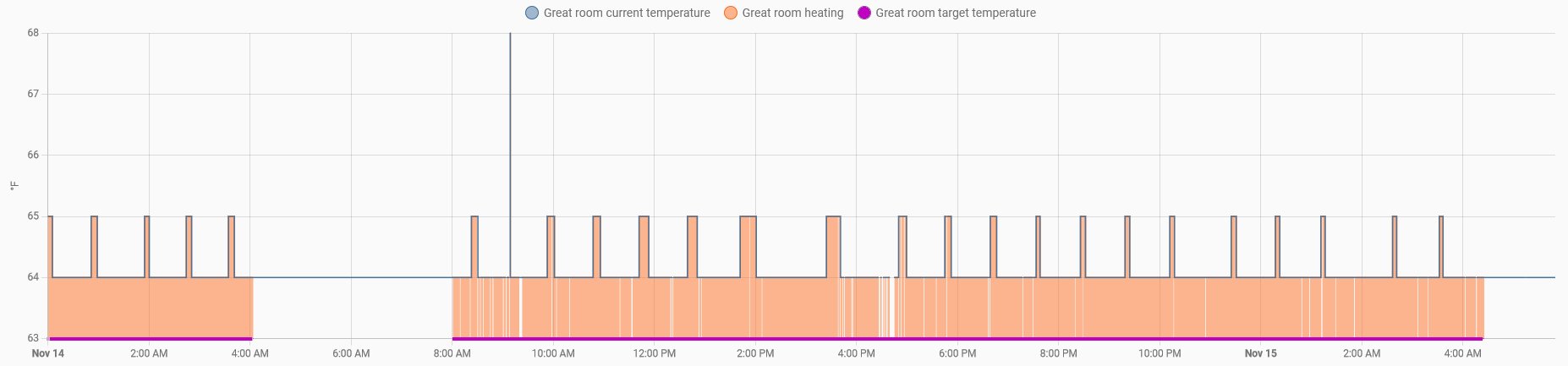
The graphs below are for the last 30 hours or so and overlap with some of the data I posted yesterday. They also include another night of heating with the 18 kBtu/h heat pump. The first graph is what Home Assistant gets from the Mitsubishi Kumo Cloud interface regarding the settings of the heat pump. The second graph is the Govee temperature data and the third is electric power from both the heat pump (blue) and the electric heaters (purple).

For most of this time I am heating with the heat pump. In early afternoon (2-4PM) solar gain through the windows causes the Govee temperature to rise above set point and the heat pump throttles back. The HP was turned off from 4-8AM yesterday to heat for 2 hours with electric then 2 hours with propane. The electric heater power data are shown in purple.

The first graph clearly shows that the set point (purple) is 63F while the measured temperature of the wireless sensor (blue) bounces between 64 and 65. I simply do not understand why the Mitsubishi control software maintains an average temperature above the set point.

Some Preliminary Results: Mini-split heat pump saves energy (and cost) but has poor temperature regulation

As I have indicated, this heating season I will be using my guest house in Maine to study the energy performance of two Mitsubishi mini-split heat pumps.  Already some interesting results are emerging.  So far this season, with outside temperatures 23°F and above, the heat pumps demonstrate considerable energy (and cost) savings as compared with electric, baseboard heat.  My students and I are starting to quantify the savings.  Here I report on some preliminary results.

We have three ways to heat the guest house: 1) Two Mitsubishi mini-split heat pumps (one 6kBtu/h and the other 18kBtu/h), 2) A 20,000 Btu/h Rinnai propane vented wall furnace, and 3) three 1.5 kW ceramic electric heaters (together, 15,400 Btu/h) distributed throughout the open space.  Each of these three systems has its own remote thermostat.  The heat pumps each have a wireless remote thermostat mounted on the wall across the room.  The Rinnai is controlled remotely by an Emerson Sensi thermostat, also wall-mounted across the room.  And the three ceramic electric heaters are individually plugged into smart outlets that are controlled by Home Assistant using software to mimic a simple on/off thermostat, with temperature measured by a Govee WiFi thermometer sitting on a cabinet near the Sensi thermostat.  Because the Govee thermometer reads in 0.1°F increments, it is the common metric used for determining the Cottage inside temperature.

My Home Assistant Heating Dashboard is shown below. All of the heating and monitoring systems can be remotely accessed.

Solar gain is a big factor during the day, so our heating experiments are conducted at night.  Last night we heated the guest house for several hours using three of the four heating systems (just used one heat pump).  The results are shown below.  The first graph shows the Govee temperature from 4 PM yesterday through 10 AM this morning (11/14).  Until 4 AM space temperature was maintained by the 18 kBtu/h heat pump.  Early yesterday the set point for the heat pump was 65°F but was lowered to 63°F around 6:40 PM yesterday.  At 4 AM the heat pump was turned off and the interior temperature was maintained for the next two hours with the three 1.5 kW electric heaters.  At 6 AM heat switched from electric to propane.  Both the propane and electric heat had set temperatures of 64°F.  At 8 AM the propane heat was terminated and control was given back to the 18 kBtu/h heat pump.

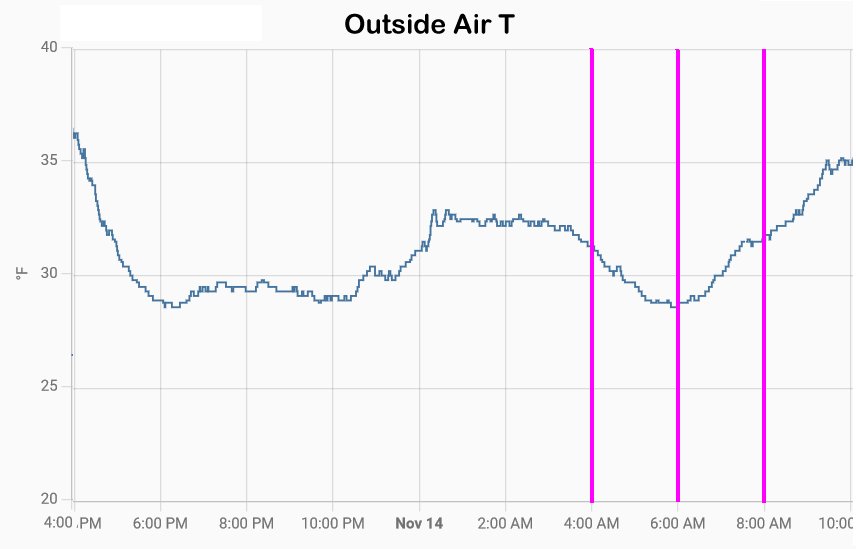
The outside temperature, measured with our Ambient weather station is graphed below. The purple lines indicate when the heating system was changed.  From midnight on the outside temperature stayed within 2°F of an average value of about 31°F.

The electric power to the heat pump and the electric heaters were continuously monitored.  The average electric power to the heat pump between midnight and 4 AM was 553 Watts.  From 4AM to 6AM the electric heaters had an average power of 1830 Watts.  That is, the electric heaters used 3.3X the power used by the heat pump.  Without adjusting for the change in outside temperature this implies a heating COP = 3.3.  This is great news.  It means 3.3X lower heating cost than with electric resistive baseboard heat.

But there seems to be a small price to pay for this energy savings.  The temperature regulation with the heat pump is not nearly as good as with either of the other two heating systems.  The heat pump caused temperature swings of about 2°F while the other two systems have swings of only 1/5th  this amount.  Moreover, the average temperature maintained by the heat pump is well above its 63°F set point.  (Even when you graph the temperature determined by the heat pump’s remote wireless sensor you see that it is always above the set point.)  One has to wonder why the control software for the heat pump is not able to do a better job of maintaining the desired temperature.  There appears to be no ability to change the “deadband.” for this unit.

We are still working on metering the propane flow in order to understand the energy use for the propane heater.  We hope to have this metered soon, it has proven more difficult than we imagined.

But even without metering the propane, I know how much propane should have been burned from 6 – 8AM.  From 4-6 AM the electric heaters provided 1.830kW x 2 h = 3.7 kWh of heat.  I am paying $0.30/kWh for electric so my cost for this electric is $1.10.  3.7 kWh of energy is equivalent to 12,500 Btu.  My propane furnace is rated at 80% efficiency.  So to deliver this amount of heat requires that it burn 15,600 Btu of propane.  The energy content of a gallon of propane is 91,452 Btu.  So I would have had to burn 0.171 gal of propane which, at a cost of $4.29 per gallon, would cost me $0.73.

Hence, 2 hours of heat last night cost me $1.10 using electric heat, $0.73 using propane, and $110/3.3 = $0.33 using the electric heat pump, this with an outside temperature of nearly freezing. The only downside of the heat pump is the lack of temperature control.  I am optimistic, however, that we can learn how to use the heat pump better to achieve better control.

One final thing to note is that when I look at the specs for this Mitsubishi compressor, MUZ-FS18N it appears to me that for a wet-bulb outside temperature of about 30°F and a dry-bulb inside temperature of 65°F the heating COP should be 3.21, consistent with my measurement of 3.3.