Heat Pump retrofit to house with resistive electric heat

In this post I want to talk about the cost-effectiveness of retrofitting my 3-bedroom house in Pemaquid with mini-split heat pumps. Four years ago, just before I had our first mini-split installed, the house was heated with electric resistive, baseboard heaters. The house was shut down in the winter (water drained, heat turned off) so these heaters were used sparingly in spring and fall. We spent our first winter here four years ago so decided to invest at that time in one mini-split heat pump that served the central living area.

We now have four single-zone, mini-split heat pumps installed, a 15 kBtu/h unit for the main living space and three smaller units (6 kBtu/h, 9 kBtu/h, and 9 kBtu/h) in an office and two bedrooms. Electric baseboard heat remains the only heat in the third bedroom — but my wife likes a cold bedroom so we NEVER use that electric heater. We regularly use a small, 1.5 kW ceramic electric heater in the bathroom — this heater runs about 1 hour a day.

The heat pumps provide summer cooling, but this is not their main function. They were installed to lower our heating cost. Electricity is expensive here in Maine and I was led to believe that heat pumps would use about 1/3 as much energy as the electric resistive heat. Based on my data I find that they are not, on average, that efficient. Instead they use 1/2 the energy (average COP = 2) used by electric heaters.

While I have electric bills from previous years, it would not be useful to compare them with my more recent bills. Everything in the house is electric — hot water heater, stove, clothes dryer, etc. — so with three people now living in this house full time the energy use is too different from what it was in previous years when we only summered here.

Shortly after installing the heat pumps I installed Iammeter electric power monitors that keep track of their energy use. These devices and their associated cloud storage have been very reliable and I strongly recommend them.

The heat pumps have been installed incrementally over four years. The larger unit was installed in October 2020. After rebate the net cost to me was $3,369. The office unit (6 kBtu/h) was installed in October 2021. After rebate my net cost was $2,789. The two bedrooms units (9 kBtu/h each) were installed in September 2024 after I moved permanently to ME. After rebate my net cost for these two units was $7,800. I am still hopeful that I will receive a $2000 federal tax credit (tbd) which would lower my net cost to $5800. Assuming I do get the tax credit, our net investment in these heat pumps is just about $12,000.

This heating season (Oct. 1 – March 20) all four heat pumps have used 3884 kWh. As I did earlier, I will inflate this a bit (multiply by 7/6) to account for electricity I expect to use for the remaining 6 weeks or so of the heating system. This gives a projected use of 4,500 kWh, which, at $0.25/kWh has a cost of $1,233.

Based on my assessment that the average COP for these heat pumps is 2.0, that means that I expect had I not purchased these heat pumps, I would have supplied this same heat with electric heaters at double the energy use, or a projected cost of $2,266. That means the heat pumps saved me half this amount, or $1,233.

If you divide my capital investment by my annual savings (for just this year, of course) you get a simple payback time of about 10 years. That is the expected lifetime for the heat pumps. Keep in mind that I already had electric baseboard heaters installed. There was no capital investment in continuing to use them.

The return on investment is much worse if I consider only the heat pumps I recently added to the two bedrooms. My daughter keeps her bedroom fairly warm and her door is usually closed. For the heating system her heat pump has used 867 kWh which, multiplied by my 7/6 factor is 1000 kWh. Based on earlier analysis this is the savings as compared with the baseboard electric heat that was formerly in her room — a savings of $253. If I divide the $5,800 cost of these bedroom units by two, then this heat pump cost $2,900 to install. The simple payback is 11.5 years. The savings for our guest bedroom are far lower and the ROI for that much lower.

Investing in these two heat pumps was a bad decision. I think I am happy with my investment in the first two heat pumps — it is not a slam dunk case, but overall I am happy with that initial investment. These two heat pumps have a simple payback time of 7 years.

Of course, there is still the air-conditioning benefit. But this is far less than I had imagined. For the last year’s cooling season (June 1 – Oct. 1) the two house heat pumps used a total of 222 kWh. The two cottage heat pumps for this same period used 80 kWh. In both cases, these heat pumps provided welcomed dehumidification and cooling for some very warm summer days and nights. But this relief could have been easily delivered by much cheaper window air-conditioners.

I realize that this is an over-simplification of cost/benefit analysis. I have not included any maintenance cost. With out-of-control inflation I don’t know how to account for the rapidly increasing cost of the heat pumps nor the increasing cost of electric energy (and other fuels). But I think the basic ideas I have presented are sound. Other smart people might make different assumptions that then produce different conclusions. I think a full discussion is needed.

Note that I have used only my net cost in determining my simple payback time. Someone else pays for the subsidies, and I question whether it is good public policy to encourage people to invest in something that, at full price, is not cost-effective. The subsidizing organization is happy with their return on investment (carbon savings per their invested dollars) and the home-owner is happy with his/her investment. Both claim success while, in fact, the overall investment is not cost-effective. This is an important issue that I have not addressed.

My conclusions rely entirely on my determination that the effective annual heating COP is 2.0, not higher. Many will disagree with this conclusion — but I don’t see any real world data to demonstrate the average COP is higher. Measuring COP in the laboratory under stringent conditions is not the same as evaluating performance in the field with uncontrolled conditions. I have found it very difficult to determine the heat delivered by the heat pumps and have worked hard to nail this down. I have confidence in my measurements. More to come.
Cost-effectiveness of mini-split heat pumps in Maine cottage

I have to begin by making this disclaimer — there are many issues involving cost that I cannot address. I don’t install or maintain hvac systems. I am the wrong guy to provide cost estimates for many things. What I can do here is compare the fuel costs and some capital investment costs for different heating systems that I have purchased — based on my limited experience.

The single thing I bring to this discussion is that I have, I believe, determined the average heating COP for the Mitsubishi heat pumps used in my house and cottage. This COP = 2 is different from the aspirational numbers that are supplied by those who sell and promote heat pumps. I don’t know of other studies that really nailed this.

Fuel Cost

First, let’s talk about fuel costs. Heating a residence involves heating the building. This heat has to come from some source of energy that you typically have to pay for. Here I will compare my heat pumps with three kinds of alternative heating systems: 1) electric baseboard heat, 2) through the wall propane heater, and 3) a home-heating oil furnace or boiler.

In my earlier post I provided a table with various assumptions regarding the fuel required for each of these systems to deliver 1,000,000 Btu of heat. Let’s now talk about fuel cost. This is very specific to location — my electric cost in Bristol, ME is nearly double what it was in Oberlin, OH. In OH I heated with natural gas. I don’t have access to natural gas here in Bristol, ME — only propane and home heating oil.

I am paying $0.25/kWh for electricity here in ME. This charge is always increasing, and who knows what it will be in a few months owing to the tariff war with Canada. The actual billing formula is complicated, but if you take my monthly bills and divide by the number of kWh I purchased for many months it averages to this.

And I am billed $5.09/gal for propane by my local supplier. This is not representative — I use very little propane and the per gallon price is high because of that. If I used 300+ gallons a year the price from my supplier changes to $4.39/gal. The maine.gov web site lists the statewide average prices (as of March 10) for propane and home heating oil to be $3.53 and $3.76. For my table below I will use $4.39/gal for propane and $3.76/gal for home heating oil.

While natural gas is not an option for me in rural Maine, it clearly is the dominant heating fuel in much of the USA, and is available in Portland and other larger cities here in Maine. The billing formula for natural gas is complicated, but the maine.gov web site lists typical February gas bills for residences in five areas that use 149 therms of gas (1 therm = 100 cu. ft.). If I average these prices I obtain $2.14 per therm or $0.021 per cf of natural gas.

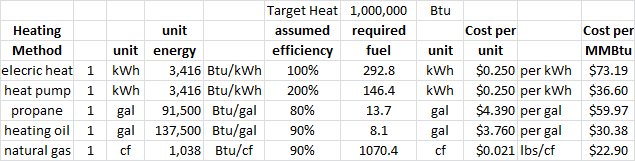
The above numbers are folded into the tables that I posted earlier to yield the table below that shows the relative cost to produce 1,000,000 Btu of heat using different heating systems. The last column shows the cost per million Btu of heat delivered.

Clearly natural gas is the cheapest option, by far, with respect to fuel costs. This option is not available to me here in Bristol, ME. Of the options available to me, home heating oil at $30 (per million Btu) would have the lowest fuel cost, with the heat pump at $37 being next. Higher yet is propane at $60 (or $69 using the price I am actually paying), with electric resistive heat highest at $73 per million Btu.

So based simply on fuel cost, the electric heat pumps are the cheapest heating option available to me — though I have not considered a wood stove.

Capital Investment

I don’t have the expertise to discuss the capital costs for all of the possible hvac systems available. But I can speak to what I actually paid to install heat pumps at my house and cottage, and what I paid to install a through-the-wall propane furnace for my cottage. And, I have installed base board electric heat in my house.

My 1000 sf cottage has a very open architecture and my centrally-located, through-the-wall propane furnace does a wonderful job of heating it in the winter. (See earlier post for more information.) The furnace is a Rinnai EX22 that delivers heat at a maximum rate of 16,560 Btu/hr. The manufacturer claims 80% efficiency. This system cost me (2021) $4,700 to have installed, along with the propane lines and tank that support it. It is difficult to know how long it will last, but it is robust and I see lots of older units still in service. I will estimate the useful life to be 15-20 years.

I also had two Mitsubishi, low-temperature, mini-split heat pumps installed in the cottage, one a 6 kBtu/h size and the other a 18 kBtu/h unit. They both dump their air into the same space (from opposite ends of the cottage). In the heart of winter I run them both, but I have on occasion staged their use, using only the smaller or larger unit depending on the outside temperature. (I figure one unit will run more efficiently when not competing with the other to control temperature.) The invoice for this project was $8,921. Efficiency Maine provided a $1200 rebate. So my net cost was $7,721.

It was not necessary to install both the propane furnace and the heat pumps. I did this mainly so that I could study heat pump performance. I wanted a back up system in case the heat pumps failed in real cold weather and also an alternative if we lost power. Propane alone would have been sufficient.

To find the economic savings provided by my cottage heat pumps I first have to determine the annual energy required to heat the cottage — and that, of course, will vary from year to year. Since September 1, 2024 the cottage has been exclusively heated with the heat pumps with a constant set temperature of 67oF. From Sep. 1 through Mar. 16 my cottage heat pumps have used 2222 kWh of electric energy. At a price of $0.25/kWh this has cost me $556. We still have another 4-6 weeks left in the heating season. To account for the remaining energy (and I will confirm this later this year) I will multiply this number by 7/6. This puts my heat pump heating energy cost for this heating season at about $650.

Using numbers in the above table I can then calculate what it would have cost me to heat with resistive electric or propane. Resistive electric would have cost me double this or $1,300 and propane (at the $4.39 price) would have cost me $1,070. At $5.09/gal, the price I actually pay the cost of propane, the annual cost would have been $1230. (The projected annual use is 242 gallons which does not qualify for the lower price.)

Based on the above numbers, the annual savings for heat pumps as compared to electric resistive heat is $650 and the annual savings as compared with propane is $416 or $582, depending on whether I use the lower or higher propane price. Of course, the heat pumps required more capital investment and are expected to have only a 10 year service life.

I don’t actually know what it would have cost me to install electric baseboard heat in the cottage. At Home Depot an 8-ft long, 2 kW baseboard heater sells for $130. I would probably need to install two of these along with five or so 4-ft. models ($67 ea.). I would need to run appropriate electric circuits and add thermostat control. I did all the electrical work in my cottage and could do the wiring for these — but an apples-to-apples comparison requires I get a price for installation. Let me defer this for now.

The heat pump installation cost me about $3,000 more than did the installation of the propane heater. With a fuel cost savings of $416/year, the simple payback time (for the additional capital cost) is 7.2 years. With the higher propane price the savings is $582/year, the simple payback time is 5.1 years.

And, of course, the heat pumps provide me with cooling during hot humid summer nights. This is not so important in the cottage as it is located on the shore of the Pemaquid River where their is more summer wind. But this is of some importance in our house which is farther inland.

I don’t know what to say about maintanence costs. So far my installer (Dave’s Appliance) has provided service without any additional charges. The manufacturer’s warranty is 7 years and I have not experienced problems with the heat pumps. That, of course, will change. But so far I have not had any maintenance costs.

There are many more issues to discuss, but this post is getting too long. In future posts I will discuss the cost/benefit of the heat pumps in my house, share data on the temperature control (which is significantly more stable with electric baseboard or propane heat), and share data that I used to learn the average COP was equal to 2.

Carbon savings with electric heat pumps in rural Maine

In my previous post I mentioned that my mini-split heat pumps are clearly lowering carbon emission, as compared with alternate ways I might heat my house. Here is the justification for that conclusion.

First, Maine has a relatively low carbon electric grid. It does not come cheap. Maine has some of the highest electric rates in the country. On average I pay $0.23/kWh for my electricity.

The EPA e-grid web site lists the following characteristics for the electric grid in this region. You really have four different ways of thinking about it — and I will tell you which I believe is the best way. First, organized by state Maine’s electricity has a footprint of 0.311 lbs CO2/kWh of electric energy. Second, we are part of the NEWE e-grid sub-region. That sub-region is listed as having 0.537 lbs Co2/kWh. Third, Maine is contained in the NPCC Nerc region which is listed as having 0.506 lbs CO2/kWh. And finally, our grid is part of the New Brunswick System Operator Balancing Authority which has a carbon footprint of 0.169 lbs CO2/kWh. (The New Brunswick Canada grid is almost entirely powered by hydro.)

It is difficult to know which of these numbers better reflects the carbon footprint of electricity I buy from the grid. Let me use the most conservative number of 0.537 lbs/kWh. Below I will offer yet another figure that I believe is more reflective of the true situation.

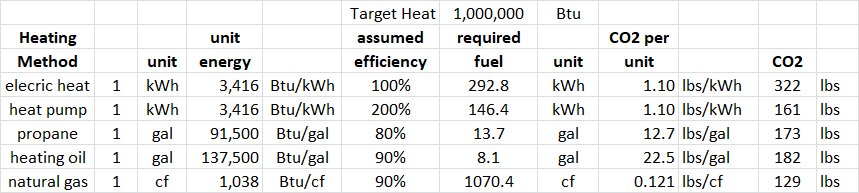
Consider propane heat as an alternative. Propane has a heat content of 91,500 Btu/gal. The carbon emission from burning a gallon of propane is 12.7 lbs/gallon. Most propane heating systems are 80% efficient (i.e., lose 20% of the heat up the chimney) although condensing furnaces can be as high as 92% efficient.

Consider the home heating oil alternative. Home heating oil has a heat content of 137,500 Btu/gal. The carbon emission from burning a gallon of home heating oil is 22.5 lbs/gallon. Depending on the age of the unit efficiency can range from 70-92%. Google reported home-heating oil furnaces can be as high as 99% efficient, but I don’t believe that for one minute. That was probably obtained with AI from a middle-school science report posted somewhere on the web. At best I would say 90% efficiency.

Finally, consider natural gas as an alternative. Natural gas is not available in rural Maine, but is available in some cities including Portland, Lewiston, Bangor, and Brunswick. Natural gas is, of course, widely available in many other states — but the comparisons presented here apply only to Maine’s electric grid. Natural gas heat content of 1038 Btu/cf. The carbon emission from burning a cubic foot of natural gas 0.121 lbs/cf. Like for home heating oil natural gas efficiency ranges from 70-92%. Most new natural gas boilers and furnaces are close to 90% efficient.

The final number to required is the conversion between kWh and Btu energy units. That conversion is 1 kWh = 3,416 Btu.

Here I assumed reasonable efficiencies for the various systems. Certainly older heating systems will be even less efficient.

Here we consider five heating systems listed in the table below. The question is how much CO2 do they emit (directly, or indirectly) in producing 1,000,000 Btu of heat. The calculations are easily accomplished with a spread sheet, and are shown in the table below.

What the table shows is that the electric heat pump with COP = 2 (200% efficiency) has the lowest carbon footprint — again, using a conservative estimate of the carbon footprint for the Maine electric grid. The next lowest carbon footprint would be for a 90% efficient natural gas boiler or furnace. This option is not readily available in rural Maine. Resistive electric heat has double the footprint of the heat pumps, but using Maine electricity, still has lower carbon than propane or a system that uses home heating oil.

Bottom line, given the various heating systems available to me, my heat pumps have the lowest carbon footprint — at least with the assumptions I have used.

I must point out, however, that you could look at the carbon footprint of the electric grid differently. Maine’s electric grid is what it is. My adding the load of a heat pump to the existing grid means that the load goes up. How is that load met? Given the economics of power the grid is always using generators with the lowest marginal cost of operation. So renewables are being maxed out, as is hydro and nuclear. If you need more power at any point it is obtained by ramping up a natural gas peaking plant. So the argument could be made that additional load on the grid has the carbon footprint of a natural gas peaking plant — which is much higher than the carbon footprint.

Again, the basic argument is this. If I have an electric heater and I stop using it — this will lower the demand on the electric grid, and accordingly some plant that is supplying electric to the grid will be ramped down. The plant that is ramped down will be the one with the largest fuel cost (i.e., marginal cost of operation). It won’t be a wind turbine, hydroelectric, or solar because they have no fuel cost. The energy saved will be the natural gas that is not needed in a gas peaking plant. In other words, in thinking about the carbon footprint of an electric load we should not look at the average carbon content of the grid, but rather the carbon saved or used when the load is decreased or increased.

A natural gas peaking plant has an efficiency typically of 30-42%. Let’s just call this 36%. At 36% efficiency a peaking plant would need to burn 9.14 cf of natural gas, which then has a carbon footprint of 1.1 lbs. In other words, no matter how clean the overall electric supply is for Maine or any other region — the marginal change in carbon emission when you increase or decrease the electric demand is 1.1 lbs of CO2. I would argue that this figure of 1.1 lbs/kWh is the relevant metric to use for deciding whether to use electricity or a fossil fuel to produce heat.

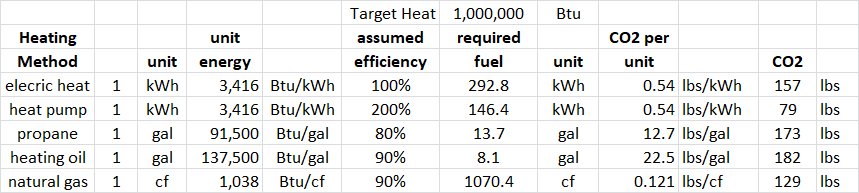
How do the above calculations change if this figure is used instead of the one used earlier (0.53 lbs/kWh)? With this carbon footprint for electricity, our Table above changes.

With this view, natural gas remains the best option for lowering carbon emission. The next best is the electric heat pump. Both propane and home heating oil still have higher carbon emission than an electric heat pump. The worst is resistive electric heat.

This view will not be popular — and many intelligent, committed advocates of sustainability will disagree. But I believe this is the correct way to think about this. Note that if the heating COP of the heat pump was higher — say 3 rather than 2 — then the heat pump would have a lower carbon footprint than any of the fossil fuel options — even when using electricity produced from burning natural gas in a peaking plant. And that would be the same in any state. Here in rural ME I don’t have the natural gas options — so even with COP = 2, the mini-split heat pump is my best option for lowering carbon.

I believe in just a few more years we will see new heat pump technology that does achieve a COP of 3 or higher over a wide range of operating temperatures. When that happens I will be a strong advocate of heat pumps — subject of course, to a cost/benefit analysis. This will be the subject of my next post.

Main Conclusions from Heat Pump Study

After using Mitsubishi mini-split heat pumps in two houses for two winters I am finally prepared to share my conclusions on their operational cost and ability to maintain comfortable temperature. It will take a number of posts to unfold the details and nuances, and to compare heating costs with fossil fuel alternatives, but here are my main conclusions.

First, these heat pumps, using electricity purchased from Maine’s electric grid, have a lower carbon footprint than other forms of residential heat owing to the relatively low carbon footprint of Maine’s electric grid. This is the main reason electric heat pumps are being heavily promoted in New England, and from a public policy perspective, are achieving the important goal of lowering carbon emission.

Second, my Mitsubishi heat pumps were able to maintain reasonably comfortable inside temperatures (65-70oF) with the outside temperature as low as -5oF. During one extremely cold weekend (-15oF) the heat pumps struggled to keep my cottage above 50oF inside — but we did not fear freezing pipes and the extreme temperatures lasted just 1-2 days.

Third, on average, my mini-split heat pumps use about half as much energy as would electric baseboard heaters to accomplish the same task. That means they cost half as much to operate as electric resistive heat. In tech language, averaged over my winter conditions, the heat pumps demonstrated an effective heating COP = 2. These energy savings are meaningful but considerably lower than those advertised for these heat pumps which are said to have heating COP’s as high as 3.5. That may be true under certain conditions, but averaged through my heating season they are far less efficient.

The fourth conclusion is that temperature regulation and comfort delivered by my heat pumps, while acceptable, is inferior to that delivered by either my electric heat or propane through-the-wall heater. Even though the set points on the heat pumps remain constant, the indoor air temperature, measured by independent temperature sensors, show fluctuations in temperature in the range of plus/minus 1.5oF. These fluctuations are significantly larger than those experienced with other heaters and display an irregularity that is difficult to understand.

The fifth conclusion is that the cooling and dehumidification provided by these heat pumps is welcome in the summer. However, while providing a degree of comfort not afforded by other heating systems, it comes at the cost of additional electric use and greenhouse gas emission.

In the next few months I will be posting details to justify the above conclusions. In addition, I will discuss the capital investment required to install these heat pumps, and look at the cost-effectiveness of the electric savings delivered. An electric heat pump can be a cost effective way to both heat and cool a residential space. But it is not always the cost-effective solution, particularly if cooling is not required.