I think it has been two years since I have posted on this blog. This post is the beginning of a new direction for me.
A couple of years ago my wife and I built a small guest cottage on our property in Maine. Mostly we will use this in the summers, but we decided to go ahead and make it a year-round house. I also decided to make it a laboratory for understanding the performance of a couple of heat pump technologies.
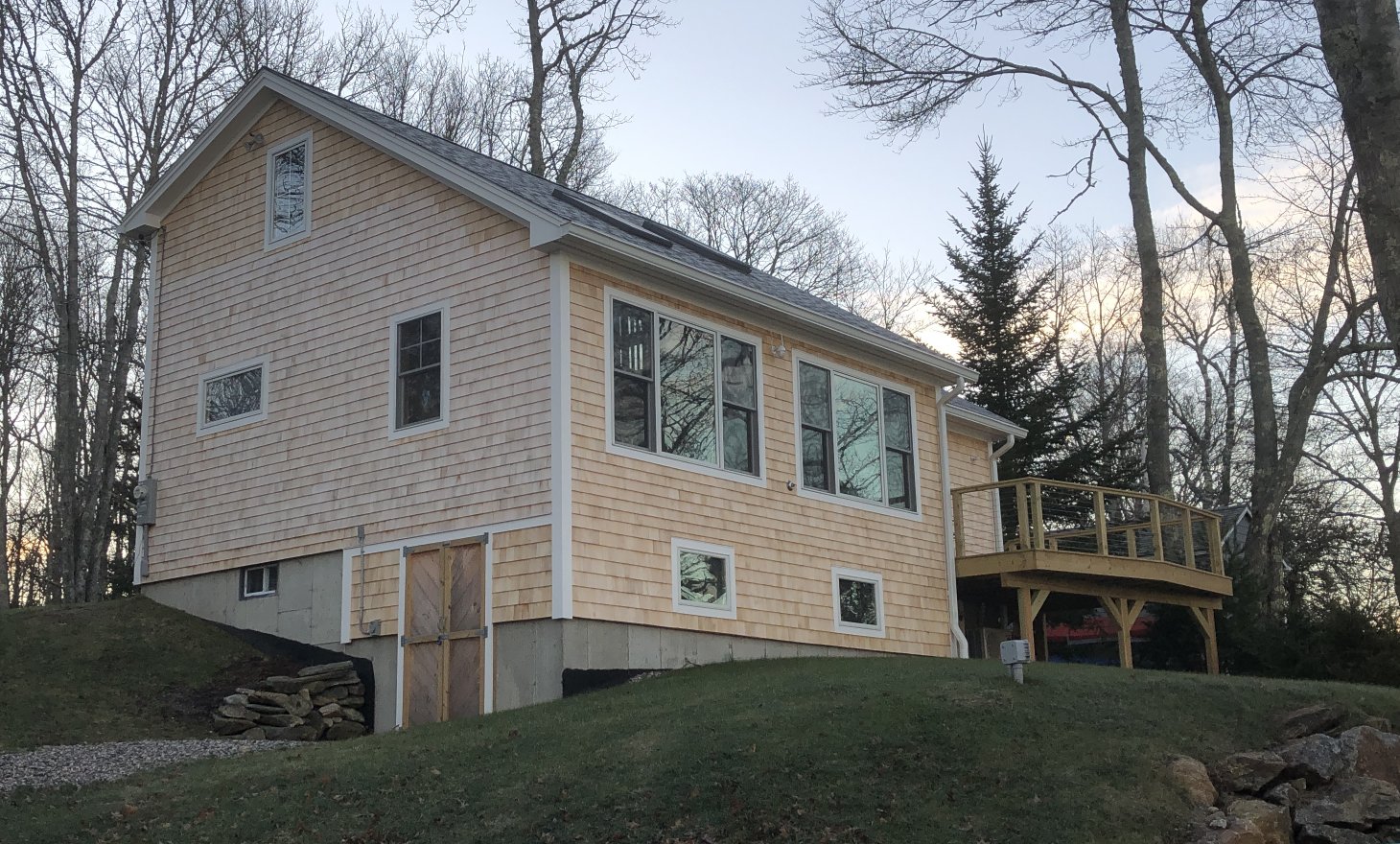
The house is outfitted both with a Rinnai direct vent propane furnace as well as two Mitsubishi, low-temperature, mini-spit heat pumps. We were going to use an electric hot water heater but, instead, decided to install a Rheem hybrid heat-pump hot water heater. Heat pump hot water heaters offer the potential for considerable energy savings in the summer, but savings in the winter are less obvious. I am anxious to study this.
For the next year I intend to report on my findings for this guest cotttage. I have some systematic experiments planned to answer questions such as:
- what is the efficiency (or heating COP) for these heat pumps at different outside temperatures
- how does the cost of heating with propane compare to those using electric heat pumps
- how does the carbon footprint compare between propane and heat pumps
- do night time setbacks produce energy savings with heat pumps as they do with propane
- how does the energy use of my heat pump hot water heater compare with an electric hot water heater
- what is the impact of the heat pump hot water heater on my winter heating costs
I hope to yield definitive answers to some of the above questions. No doubt other questions will come up along the way.
I am primarily interested in the winter performance of these systems.
During the summer we will have guests using the cottage and that will make it difficult to control various parameters. During the winter my wife will be using the cottage during the day as her office. In the evenings it will be unoccupied — which leaves me excellent opportunity to control the environment. Both day and night the indoor temperature will be closely controlled and documented.
To record data and to control parameters we are running Home Assistant (HA) on a Rasberry Pi 4. All of the relevant devices in the cottage communicate with HA. This allows me to both read and control the heat pumps, hot water heater, propane heater, various temperature and humidity sensors, lights, dehumidifier, electric heaters, etc. Iammeter energy monitors have been installed on the main electric panel and both heat pumps. These communicate with HA, as well. There is also a weather station about 100 ft away from the cottage connected to Weather Underground.
Our main house also contains two Mitsubishi mini-split heat pumps. These, too, along with iammeter power meters attached to each, are monitored with HA.
While a lot of the instrumentation was being developed and installed this last year, we do have some preliminary results worth sharing. These will be the subject of upcoming posts.
 The Pragmatic Steward
Glad to see you back! Looking forward to the findings! Measuring COP of air source heat pumps is tricky, curious to see your solution!
Nate you are so right about the difficulty in determining the COP. It is easy to measure the electric energy used by the heat pump — that is accomplished with my iammeter energy monitors. The difficult part is to know how much heat was delivered. I have some ideas about how to accomplish this and will share them when I get there. They may or may not work — we will see.
You might check out the MeasureQuick app, it may be of help. I’m very curious to see if your measured COPs come close to the spec sheets. Air to water is so much easier to measure! But air to air is what we use in the US.
Thanks for the suggestion — I will check it out.