Mitsubishi Mini-Split Comfort App Roll-Out a Disaster

This post may not be of interest to most my followers, but I hope it will be helpful to other Mitsubishi mini-split owners who use the Kumo Cloud App with WiFi to control their heat pumps.

Yesterday all six of my heat pumps began disconnecting from my WiFi and I have not been able to communicate with them until about 9:30 AM this morning. The details are strange and suggest to me that Mitsubishi has pushed some firmware update to these six devices that prevented them from connecting to my WiFi until mid-morning. As of this moment they seem to have restored their network connection — but there is no communication from Mitsubishi that explains what is going on.

What follows are more details of my experience. If you don’t own Mitsubishi mini-splits or use Kumo Cloud you probably won’t be interested in reading on.

I have six Mitsubishi mini-split heat pumps that are all connected to my network with WiFi adaptors that communicate using the Kumo Cloud App. Apparently Mitsubishi is in the process of rolling out a new app to replace Kumo Cloud. They call it Comfort by Mitsubishi Electric. If you go to the Apple App store and try to download Kumo Cloud you will get this new app, instead.

I have updated to the new app on my ipad, but on my iphone I did not update so that I still have the original Kumo Cloud App.

My Home Assistant program actually uses a Kumo Cloud integration to control/monitor my heat pumps over my local area network — uses the ip addresses and Kumo protocol to communicate with them without going out to the cloud. So even when my ISP is down and I have no internet connection, Home Assistant is still able to communicate with my six heat pumps — though the cloud apps on my ipad and phone do not have communication.

Yesterday Home Assistant lost its connection to all six of my heat pumps. I re-loaded HA, I rebooted HA, I updated HA, I rebooted the heat pumps — nothing fixed my connection. My Kumo Cloud app suggested all HP were off-line. I updated the App on my ipad to the new Comfort App, and after some time (a few minutes) it reported the HP as being disconnected from the network.

All six heat pumps have been assigned static ip addresses. I tried pinging them and they would not respond. Other devices on my network continued to work properly.

I rebooted my Deco X-20 access points. I rebooted my pfSense router. Nothing I did could get these six heat pumps to connect to my network. I spent about 3 hours this morning messing with all this.

Then, about 9:30 AM, the heat pumps began to connect to my new Comfort App. Several of them could be controlled with the new App. Others showed up, but the App said they were “off.” I see no way in the App to turn them “on.” I don’t know what off means — but the app is giving me no control of them.

I found that I could ping all six of the heat pumps again. I re-loaded my HA Kumo Cloud integration and all six heat pumps re-connected to HA. I can control them and read their parameters and HA seems to be re-connected as it should be.

But the Comfort App still shows two of the heat pumps as “off”.

And, I am not home free yet. The heat pumps are still disconnecting and re-connecting to my network. Mostly they are connected, but every now and again when I check, one or more is disconnected.

I don’t know what is going on, but this roll-out by Mitsubishi is a disaster. Their Comfort App sucks. Whatever changes they have made to their WiFi boards has bugs — and there seems to be no information provided to consumers to explain what is going on.

Coincidently, my heat pump installer (Dave’s Appliance) had a crew next door working on my neighbor’s heat pump. I stopped over and asked the service tech if he could explain what was going on with the WiFi communication. He said they are getting lots of complaints from customers but no explanation from Mitsubishi. Mitsubishi tells them that there will be erratic behavior for the next couple of months.

This is simply unacceptable.
Daily Energy Cost Graph for Cottage

Last week I posted a graph of the Cottage daily electric use. This graph is updated every day. While the graph is very useful, it does not include any propane used. While there are many days that the cottage does not use propane, I do expect to use propane for heat this winter. And there were some days in November when propane was used to heat the cottage.

As I suggested earlier, propane and electric use can be included on a single graph of daily energy cost. Electric energy costs me $0.30/kWh in Maine and propane costs $4.29/gal. (I should point out that propane cost would be significantly lower if I used much more propane. My local supplier is currently charging $3.30 per gallon delivered for customers with 1000 gal annual use. So far my use is at the 100-200 gal/year level.)

This month (December) I am using propane heat much more in order to actually compare my propane flow numbers with the amount of propane that is delivered. I received a propane delivery about a week ago, so my goal is to use a significant amount of propane in the next few weeks so that I can use the next propane delivery to calibrate my propane flow meter.

I have performed a preliminary calibration of the propane flow meter — and that calibration is being used to produce the propane costs in the above graph. But I do expect to adjust these figures once I receive the next propane delivery.

Recall from my earlier post that, under conditions that my heat pump had a heating COP = 3.3, propane heat cost was about 2.2X the cost of heat from my heat pumps. So it is with great reluctance that I turn off the heat pumps and heat with propane. Such is the cost of scientific experiments.

Heat Pump Energy Strongly Depends on Fan Speed Setting

A few weeks ago I noticed that the Mitsubishi mini-split heat pumps in my house were consuming considerably more electric energy than those in my guest cottage. This applied especially to the large heat pump (15 kBtu/h) in my house living room which carries the most load.

Since then I have looked at this more closely and concluded that the excessive energy use is assocated with the fan speed settings on the heat pumps. The fans on both house heat pumps were set to Auto while the ones in the cottage were set to High (setting 4 of 5 possible manual fan speed settings). When I switched the fan mode of the house heat pumps from Auto to High their energy consumption decreased by 30-50%. That is, they supplied more heat while using less electric energy. The change was substantial.

The data that support this conclusion are convincing. The first measurements I made were to determine the heating COP for the living room heat pump. I did this 3-4 times on different days with different outside temperatures. I obtained COP numbers like 1.95, 1.15, and 1.14. This concerned me so I reached out to my installer, Dave’s Appliance. They, in turn, told me they passed my information along to Mitsubishi. In the intervening two weeks I have not heard back from either.

I don’t know why but at some point I wondered if the fan setting might be involved. Both guest cottage and house were to be unoccupied for a few days so I set the heat pumps in both to maintain an interior temperature of 60oF, 24-hours-a-day. In addition I wrote a Home Assistant automation to change the fan speed setting at midnight so that I could observe the impact of this change on energy use. I performed this experiment with the 15 kBtu/h house living room heat pump and also with the 18 kBtu/h cottage heat pump. For both heat pumps I observed similar results. The heat pumps used 40-50% less power when the fan mode was set to High as compared to when the mode was set to Auto. I also determined that the heat pump used excess power when the fan mode was set to Medium (3rd of five manual settings). I did not try any of the slower fan settings. I have confirmed similar energy savings when the fan is set to Very High (5th of five manual settings). I believe that these conclusions apply to all four of my heat pumps, though the level of savings may vary.

After I changed the living room heat pump fan speed setting to High I again measured its heating COP. This time I obtained a value of 3.7 when the outside temperature was 30oF.

I should mention that each of my four heat pumps make use of the wireless remote temperature sensor sold by Mitsubishi. It can be purchased on Amazon. In principle, this should seemlessly integrate with my heat pumps.

This seems to me to be an important result. If I were not metering (and paying attention to) my heat pump energy I would not know they are not operating efficiently. They are producing heat and the room is comfortable. Heat pump energy use is not monitored for most installations.

But energy (and associated cost and carbon) savings is the only reason to invest in heat pumps rather than inexpensive electric baseboard heaters. After all, electric base board heaters provide more stable and quieter heat and are cheaper to install. If heat pump operation does not deliver the promised savings the heating costs and carbon footprint will not meet expectations. It is quite possible that thousands of heat pump installations in New England alone are using 50% more energy than necessary because their fans are set to Auto mode. It seems to me that Mitsubishi should care.

I don’t know if this problem is related to my use of remote wireless temperature sensors, or if it also would apply even using the internal temperature sensors. (I will not be able to disconnect my remote sensors in order to test this until I return to Maine after Christmas.) It is possible that Mitsubishi software that controls the fan may be written only for the internal tempearture sensors and is not approriate when connected to a wireless temperature sensor. I have seen nothing on the Mitsubishi web site that suggests this.

I should point out that when one uses either Kumo Cloud or the remote control to change settings on the heat pumps this often changes many other heat pump parameters. For instance, if you point the remote at the heat pump and raise the temperature, the remote also sends other parameters it has saved for fan speeds, direction, etc. Someone might set the heat pump fan speed to High using the Kumo Cloud phone app, then later adjust the set temperature with the remote and inadvertently change the fan (and other) settings to those saved on the remote.

One final comment. I did find that the temperature fluctuations were smaller when the fan was in Auto mode than when the fan was set to High or Very High. So there does seem to be a tradeoff between energy savings and temperature control. Experiments continue to better quantify this.

Follow up to Preliminary Result – electric power data

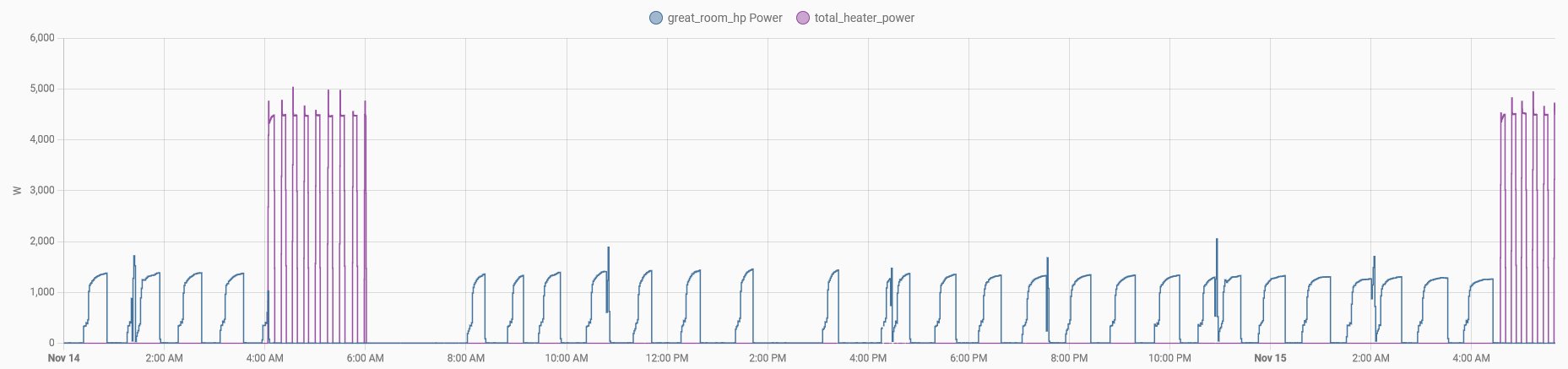
Nate Adams asked whether the heat pump was modulating its electric use to maintain temperature or cycling on and off? The power data (below) show it is cycling on and off.

The graphs below are for the last 30 hours or so and overlap with some of the data I posted yesterday. They also include another night of heating with the 18 kBtu/h heat pump. The first graph is what Home Assistant gets from the Mitsubishi Kumo Cloud interface regarding the settings of the heat pump. The second graph is the Govee temperature data and the third is electric power from both the heat pump (blue) and the electric heaters (purple).

For most of this time I am heating with the heat pump. In early afternoon (2-4PM) solar gain through the windows causes the Govee temperature to rise above set point and the heat pump throttles back. The HP was turned off from 4-8AM yesterday to heat for 2 hours with electric then 2 hours with propane. The electric heater power data are shown in purple.

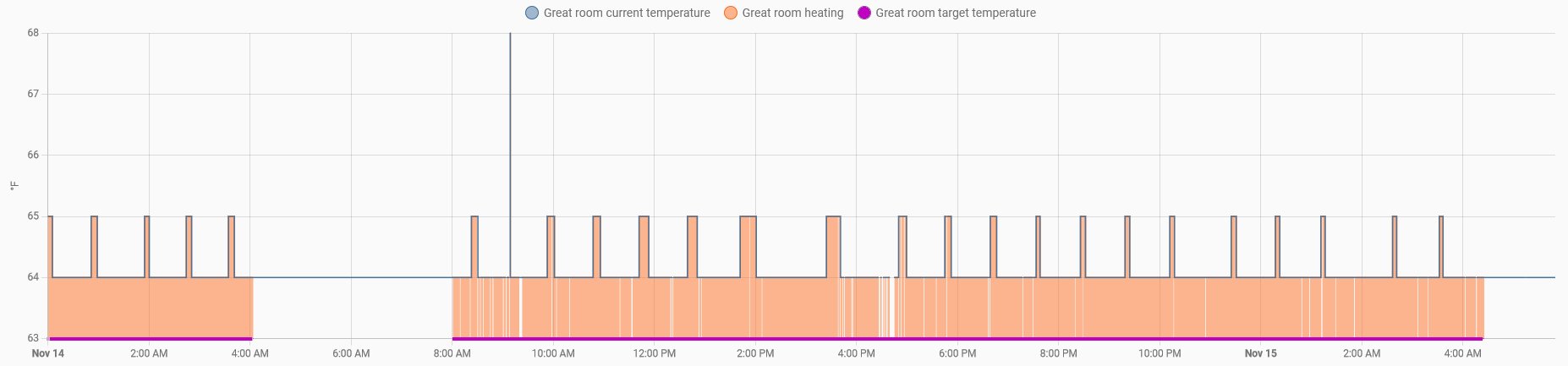
The first graph clearly shows that the set point (purple) is 63F while the measured temperature of the wireless sensor (blue) bounces between 64 and 65. I simply do not understand why the Mitsubishi control software maintains an average temperature above the set point.

Excessive Heat Pump Energy – Update

A few weeks ago in my post I described how one of my four Mitsubishi mini-split heat pumps was using excessive energy. Today’s post provides additional information about that. Apparently the excessive energy is by design! For background please revisit my August 12 post.

Just a quick recap — In the last three years I have had four, low-temperature, mini-split heat pumps installed on my property in Maine. The oldest of these is a 15 kBtu/h unit that is installed in my house living room. The model number for its outdoor unit is MUZ-FH15NA. The other three units were installed over the next two years. Their outdoor units have model numbers: MUZ-FS06NA, MUZ-FS18NA, and MUZ-FS06NA. (Apparently the “FS” models are improved over the “FH” models.) All four compressors use R410A refrigerant.

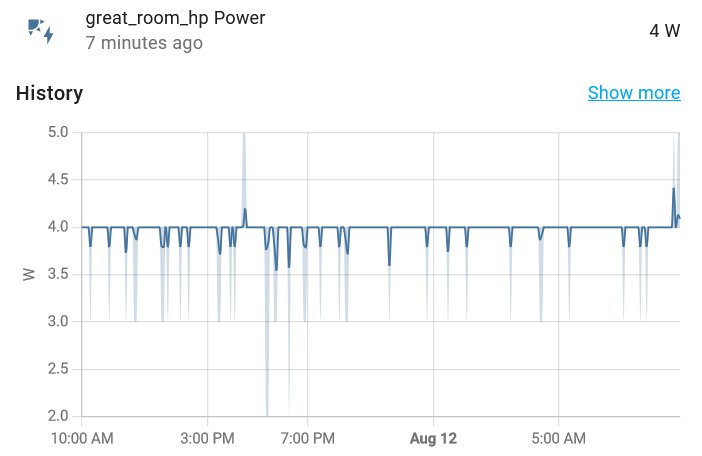
These units have seen minimal use since the beginning of May. On rare occasions we have used them for a bit of cooling or heating. They have simply remained in standby mode for nearly 120 days. Three of these use 3-4 W of continuous standby power but the oldest, the 15 kBtu/h unit, particularly during the night, experiences 70W power spikes every two hours or so that last for about 10 minutes. This causes this unit to use about 0.2 kWh per day more energy than the other three. For three months I have been seeking to understand what is going on.

Back in June I emailed my installer, Dave’s Appliance, questions about this performance including graphs and other details. I have always found Dave’s to be extremely helpful. They could not explain what was going on so they passed the information along to their Mitsubishi support team. A couple of months went by with no answer.

I pestered them some more. Finally, in mid-August, two technicians from Dave’s drove the 50 miles from Winthrop to my house to make measurements on the compressor while on the phone with their Portland Mitsubishi tech support. With the travel time, these guys spent a half day addressing my issue. The only measurements they made were to confirm that a certain thermistor had the correct value.

One of the techs who came to my house was Ean Laflin, the heat pump service manager with Dave’s Appliance. After he was done troubleshooting and speaking with Mitsubishi he explained that there was a 70 W heater in the compressor, and that the control board turned it on whenever the ambient temperature was below 68F. Presumably after the heater ran for 10 minutes the temperature of the thermistor rose above the set point causing the heater to turn off. (It is my impression that there is oil in this compressor, and this heater is intended to keep the viscosity of this oil low so the compressor will start easily when called upon.)

But this begs the question, why would this heater be activated when the ambient temperature ranges from 60F to 68F? I could see the need to heat the oil during the winter. But in my part of Maine from May – October the ambient temperature is usually above 68F for much of the day and usually drops below 68F late at night. For nearly four months I have not needed this heat pump yet the heater keeps using energy, night after night. The only way I can avoid this is to shut off the circuit breaker. This is obsurd!

So why doesn’t this same thing happen with my other three heat pumps? Ean tells me that the control board on these slightly newer models is shipped with a jumper that can be set so as to disable this feature — apparently this is the default setting. He can change the jumpers on the other three heat pumps so that all four of my heat pumps run this heater and waste energy. But there is no jumper to change on my Living Room heat pump to reduce its standby power to 3W like the other three heat pumps.

I conclude from this that Mitsubishi, after shipping thousands or perhaps millions of heat pumps with this control strategy determined it was not necessary and “improved” the next generation of control boards. The only way to “improve” my heat pump would be to install a new control board. I recognize this is not a cost effective way to save the $15/year wasted by this heater.

Which leads me to my last point. Each one of my four heat pumps is connected to the internet and can be controlled using the Kumo Cloud App. Why can’t Mitsubishi download updated firmware over the internet to fix this bug? Hundreds of millions of devices (phones, etc.) that only cost a few hundred dollars can receive updated firmware over the internet. Why can’t Mitsubishi figure this out for heat pumps that cost many thousands of dollars? The technology really needs to be updated.

Excessive Energy Use by one of my Mitsubishi Mini-Split Heat Pumps

In the last three years I have had four Mitsubishi low-temperature mini-split heat pumps installed in Maine. Two of these are smaller, 6 kBtu/h units, one is an 18 kBtu/h unit, and the oldest of these is a 15 kBtu/h unit, located in my living room.

I have been monitoring the electric use of the two cottage heat pumps for more than a year. In March 2023 I began monitoring the energy use for the two older heat pumps in the house.

This post looks at the standby power of the four units. One of the units displays, what I would characterize as strange behavior. I have reached out both to Mitsubishi and to Dave’s Appliance who installed my units and no one has explained the behavior. Perhaps someone reading this post will be able to shed light on this.

These days all four of my heat pumps have power but are turned OFF so that they provide neither cooling nor heating. They are essentially in stand-by mode. As mentioned, three of these heat pumps use about 4W of standby power. A graph of P(t) for the last day or so for my 18 kBtu/h unit in the cottage is shown below.

In contrast to the 4W standby power of the above heat pump, the 15 kBtu/h heat pump in my house living room displays the behavior shown below.

The above heat pump has standby power of about 5W during the day, then starting at midnight, has periodic spikes of close to 70W. These bursts last for only about 10-12 minutes, then re-appear about 2 house later. These bursts stop sometime the next morning, then the pattern repeats the following night.

The excessive energy use is not much on a day-to-day basis. My three heat pumps use about 0.11 kWh per day per unit in standby mode. The one with bursts of power uses about 0.23 kWh per day in standby mode. The excessive use is about 44 kWh per year which, at $0.30/kWh, costs about $13 per year. Again, the excessive energy is not that much — but what is its origin? What is it about the control of this heat pump that is different from the other three?

These graphs just illustrate that a lot is going on in these heat pumps that you would not notice if you don’t measure their power use. They all seem to be operating normally, otherwise.

I would welcome any input if anyone can explain the behavior.

For reference, the model numbers for the 15 kBtu/h units that show anomalous behavior are MUZ-FH15NA for the outdoor unit and MSZ–FH15NA for the indoor unit.

All of the heat pumps are 220VAC units. I monitor their electric use with iammeter single-phase units. The data from these units are regularly logged with Home Assistant.

Mini-split Heat Pumps and Heat Pump HW Heater

I think it has been two years since I have posted on this blog. This post is the beginning of a new direction for me.

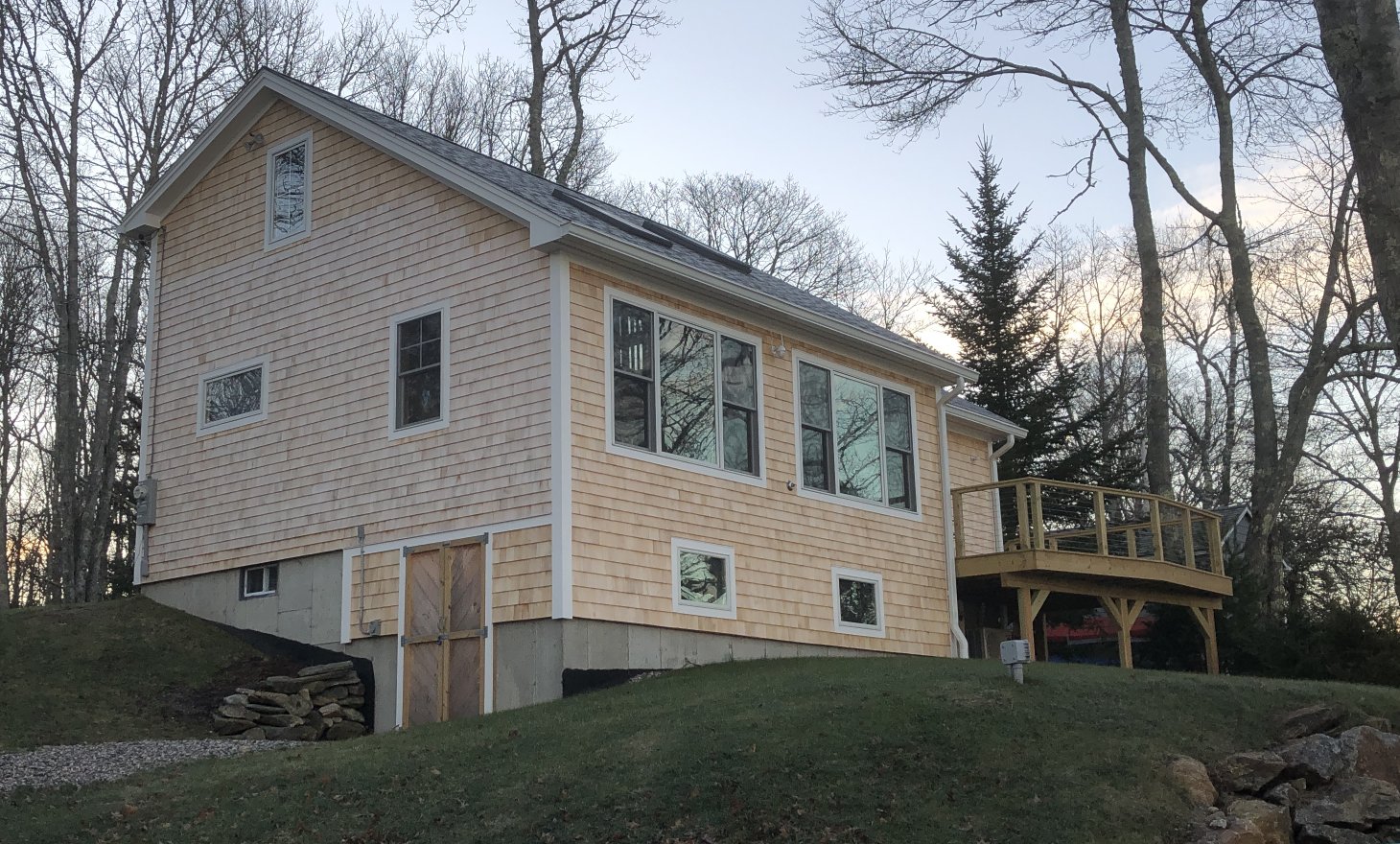
A couple of years ago my wife and I built a small guest cottage on our property in Maine. Mostly we will use this in the summers, but we decided to go ahead and make it a year-round house. I also decided to make it a laboratory for understanding the performance of a couple of heat pump technologies.

The house is outfitted both with a Rinnai direct vent propane furnace as well as two Mitsubishi, low-temperature, mini-spit heat pumps. We were going to use an electric hot water heater but, instead, decided to install a Rheem hybrid heat-pump hot water heater. Heat pump hot water heaters offer the potential for considerable energy savings in the summer, but savings in the winter are less obvious. I am anxious to study this.

For the next year I intend to report on my findings for this guest cotttage. I have some systematic experiments planned to answer questions such as:

  • what is the efficiency (or heating COP) for these heat pumps at different outside temperatures
  • how does the cost of heating with propane compare to those using electric heat pumps
  • how does the carbon footprint compare between propane and heat pumps
  • do night time setbacks produce energy savings with heat pumps as they do with propane
  • how does the energy use of my heat pump hot water heater compare with an electric hot water heater
  • what is the impact of the heat pump hot water heater on my winter heating costs

I hope to yield definitive answers to some of the above questions. No doubt other questions will come up along the way.

I am primarily interested in the winter performance of these systems.

During the summer we will have guests using the cottage and that will make it difficult to control various parameters. During the winter my wife will be using the cottage during the day as her office. In the evenings it will be unoccupied — which leaves me excellent opportunity to control the environment. Both day and night the indoor temperature will be closely controlled and documented.

To record data and to control parameters we are running Home Assistant (HA) on a Rasberry Pi 4. All of the relevant devices in the cottage communicate with HA. This allows me to both read and control the heat pumps, hot water heater, propane heater, various temperature and humidity sensors, lights, dehumidifier, electric heaters, etc. Iammeter energy monitors have been installed on the main electric panel and both heat pumps. These communicate with HA, as well. There is also a weather station about 100 ft away from the cottage connected to Weather Underground.

Our main house also contains two Mitsubishi mini-split heat pumps. These, too, along with iammeter power meters attached to each, are monitored with HA.

While a lot of the instrumentation was being developed and installed this last year, we do have some preliminary results worth sharing. These will be the subject of upcoming posts.