This post may not be of interest to most my followers, but I hope it will be helpful to other Mitsubishi mini-split owners who use the Kumo Cloud App with WiFi to control their heat pumps.
Yesterday all six of my heat pumps began disconnecting from my WiFi and I have not been able to communicate with them until about 9:30 AM this morning. The details are strange and suggest to me that Mitsubishi has pushed some firmware update to these six devices that prevented them from connecting to my WiFi until mid-morning. As of this moment they seem to have restored their network connection — but there is no communication from Mitsubishi that explains what is going on.
What follows are more details of my experience. If you don’t own Mitsubishi mini-splits or use Kumo Cloud you probably won’t be interested in reading on.
I have six Mitsubishi mini-split heat pumps that are all connected to my network with WiFi adaptors that communicate using the Kumo Cloud App. Apparently Mitsubishi is in the process of rolling out a new app to replace Kumo Cloud. They call it Comfort by Mitsubishi Electric. If you go to the Apple App store and try to download Kumo Cloud you will get this new app, instead.
I have updated to the new app on my ipad, but on my iphone I did not update so that I still have the original Kumo Cloud App.
My Home Assistant program actually uses a Kumo Cloud integration to control/monitor my heat pumps over my local area network — uses the ip addresses and Kumo protocol to communicate with them without going out to the cloud. So even when my ISP is down and I have no internet connection, Home Assistant is still able to communicate with my six heat pumps — though the cloud apps on my ipad and phone do not have communication.
Yesterday Home Assistant lost its connection to all six of my heat pumps. I re-loaded HA, I rebooted HA, I updated HA, I rebooted the heat pumps — nothing fixed my connection. My Kumo Cloud app suggested all HP were off-line. I updated the App on my ipad to the new Comfort App, and after some time (a few minutes) it reported the HP as being disconnected from the network.
All six heat pumps have been assigned static ip addresses. I tried pinging them and they would not respond. Other devices on my network continued to work properly.
I rebooted my Deco X-20 access points. I rebooted my pfSense router. Nothing I did could get these six heat pumps to connect to my network. I spent about 3 hours this morning messing with all this.
Then, about 9:30 AM, the heat pumps began to connect to my new Comfort App. Several of them could be controlled with the new App. Others showed up, but the App said they were “off.” I see no way in the App to turn them “on.” I don’t know what off means — but the app is giving me no control of them.
I found that I could ping all six of the heat pumps again. I re-loaded my HA Kumo Cloud integration and all six heat pumps re-connected to HA. I can control them and read their parameters and HA seems to be re-connected as it should be.
But the Comfort App still shows two of the heat pumps as “off”.
And, I am not home free yet. The heat pumps are still disconnecting and re-connecting to my network. Mostly they are connected, but every now and again when I check, one or more is disconnected.
I don’t know what is going on, but this roll-out by Mitsubishi is a disaster. Their Comfort App sucks. Whatever changes they have made to their WiFi boards has bugs — and there seems to be no information provided to consumers to explain what is going on.
Coincidently, my heat pump installer (Dave’s Appliance) had a crew next door working on my neighbor’s heat pump. I stopped over and asked the service tech if he could explain what was going on with the WiFi communication. He said they are getting lots of complaints from customers but no explanation from Mitsubishi. Mitsubishi tells them that there will be erratic behavior for the next couple of months.
In this post I want to talk about the cost-effectiveness of retrofitting my 3-bedroom house in Pemaquid with mini-split heat pumps. Four years ago, just before I had our first mini-split installed, the house was heated with electric resistive, baseboard heaters. The house was shut down in the winter (water drained, heat turned off) so these heaters were used sparingly in spring and fall. We spent our first winter here four years ago so decided to invest at that time in one mini-split heat pump that served the central living area.
We now have four single-zone, mini-split heat pumps installed, a 15 kBtu/h unit for the main living space and three smaller units (6 kBtu/h, 9 kBtu/h, and 9 kBtu/h) in an office and two bedrooms. Electric baseboard heat remains the only heat in the third bedroom — but my wife likes a cold bedroom so we NEVER use that electric heater. We regularly use a small, 1.5 kW ceramic electric heater in the bathroom — this heater runs about 1 hour a day.
The heat pumps provide summer cooling, but this is not their main function. They were installed to lower our heating cost. Electricity is expensive here in Maine and I was led to believe that heat pumps would use about 1/3 as much energy as the electric resistive heat. Based on my data I find that they are not, on average, that efficient. Instead they use 1/2 the energy (average COP = 2) used by electric heaters.
While I have electric bills from previous years, it would not be useful to compare them with my more recent bills. Everything in the house is electric — hot water heater, stove, clothes dryer, etc. — so with three people now living in this house full time the energy use is too different from what it was in previous years when we only summered here.
Shortly after installing the heat pumps I installed Iammeter electric power monitors that keep track of their energy use. These devices and their associated cloud storage have been very reliable and I strongly recommend them.
The heat pumps have been installed incrementally over four years. The larger unit was installed in October 2020. After rebate the net cost to me was $3,369. The office unit (6 kBtu/h) was installed in October 2021. After rebate my net cost was $2,789. The two bedrooms units (9 kBtu/h each) were installed in September 2024 after I moved permanently to ME. After rebate my net cost for these two units was $7,800. I am still hopeful that I will receive a $2000 federal tax credit (tbd) which would lower my net cost to $5800. Assuming I do get the tax credit, our net investment in these heat pumps is just about $12,000.
This heating season (Oct. 1 – March 20) all four heat pumps have used 3884 kWh. As I did earlier, I will inflate this a bit (multiply by 7/6) to account for electricity I expect to use for the remaining 6 weeks or so of the heating system. This gives a projected use of 4,500 kWh, which, at $0.25/kWh has a cost of $1,233.
Based on my assessment that the average COP for these heat pumps is 2.0, that means that I expect had I not purchased these heat pumps, I would have supplied this same heat with electric heaters at double the energy use, or a projected cost of $2,266. That means the heat pumps saved me half this amount, or $1,233.
If you divide my capital investment by my annual savings (for just this year, of course) you get a simple payback time of about 10 years. That is the expected lifetime for the heat pumps. Keep in mind that I already had electric baseboard heaters installed. There was no capital investment in continuing to use them.
The return on investment is much worse if I consider only the heat pumps I recently added to the two bedrooms. My daughter keeps her bedroom fairly warm and her door is usually closed. For the heating system her heat pump has used 867 kWh which, multiplied by my 7/6 factor is 1000 kWh. Based on earlier analysis this is the savings as compared with the baseboard electric heat that was formerly in her room — a savings of $253. If I divide the $5,800 cost of these bedroom units by two, then this heat pump cost $2,900 to install. The simple payback is 11.5 years. The savings for our guest bedroom are far lower and the ROI for that much lower.
Investing in these two heat pumps was a bad decision. I think I am happy with my investment in the first two heat pumps — it is not a slam dunk case, but overall I am happy with that initial investment. These two heat pumps have a simple payback time of 7 years.
Of course, there is still the air-conditioning benefit. But this is far less than I had imagined. For the last year’s cooling season (June 1 – Oct. 1) the two house heat pumps used a total of 222 kWh. The two cottage heat pumps for this same period used 80 kWh. In both cases, these heat pumps provided welcomed dehumidification and cooling for some very warm summer days and nights. But this relief could have been easily delivered by much cheaper window air-conditioners.
I realize that this is an over-simplification of cost/benefit analysis. I have not included any maintenance cost. With out-of-control inflation I don’t know how to account for the rapidly increasing cost of the heat pumps nor the increasing cost of electric energy (and other fuels). But I think the basic ideas I have presented are sound. Other smart people might make different assumptions that then produce different conclusions. I think a full discussion is needed.
Note that I have used only my net cost in determining my simple payback time. Someone else pays for the subsidies, and I question whether it is good public policy to encourage people to invest in something that, at full price, is not cost-effective. The subsidizing organization is happy with their return on investment (carbon savings per their invested dollars) and the home-owner is happy with his/her investment. Both claim success while, in fact, the overall investment is not cost-effective. This is an important issue that I have not addressed.
My conclusions rely entirely on my determination that the effective annual heating COP is 2.0, not higher. Many will disagree with this conclusion — but I don’t see any real world data to demonstrate the average COP is higher. Measuring COP in the laboratory under stringent conditions is not the same as evaluating performance in the field with uncontrolled conditions. I have found it very difficult to determine the heat delivered by the heat pumps and have worked hard to nail this down. I have confidence in my measurements. More to come.
I have to begin by making this disclaimer — there are many issues involving cost that I cannot address. I don’t install or maintain hvac systems. I am the wrong guy to provide cost estimates for many things. What I can do here is compare the fuel costs and some capital investment costs for different heating systems that I have purchased — based on my limited experience.
The single thing I bring to this discussion is that I have, I believe, determined the average heating COP for the Mitsubishi heat pumps used in my house and cottage. This COP = 2 is different from the aspirational numbers that are supplied by those who sell and promote heat pumps. I don’t know of other studies that really nailed this.
Fuel Cost
First, let’s talk about fuel costs. Heating a residence involves heating the building. This heat has to come from some source of energy that you typically have to pay for. Here I will compare my heat pumps with three kinds of alternative heating systems: 1) electric baseboard heat, 2) through the wall propane heater, and 3) a home-heating oil furnace or boiler.
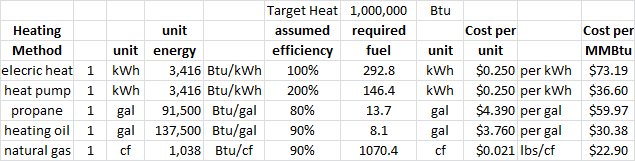
In my earlier post I provided a table with various assumptions regarding the fuel required for each of these systems to deliver 1,000,000 Btu of heat. Let’s now talk about fuel cost. This is very specific to location — my electric cost in Bristol, ME is nearly double what it was in Oberlin, OH. In OH I heated with natural gas. I don’t have access to natural gas here in Bristol, ME — only propane and home heating oil.
I am paying $0.25/kWh for electricity here in ME. This charge is always increasing, and who knows what it will be in a few months owing to the tariff war with Canada. The actual billing formula is complicated, but if you take my monthly bills and divide by the number of kWh I purchased for many months it averages to this.
And I am billed $5.09/gal for propane by my local supplier. This is not representative — I use very little propane and the per gallon price is high because of that. If I used 300+ gallons a year the price from my supplier changes to $4.39/gal. The maine.gov web site lists the statewide average prices (as of March 10) for propane and home heating oil to be $3.53 and $3.76. For my table below I will use $4.39/gal for propane and $3.76/gal for home heating oil.
While natural gas is not an option for me in rural Maine, it clearly is the dominant heating fuel in much of the USA, and is available in Portland and other larger cities here in Maine. The billing formula for natural gas is complicated, but the maine.gov web site lists typical February gas bills for residences in five areas that use 149 therms of gas (1 therm = 100 cu. ft.). If I average these prices I obtain $2.14 per therm or $0.021 per cf of natural gas.
The above numbers are folded into the tables that I posted earlier to yield the table below that shows the relative cost to produce 1,000,000 Btu of heat using different heating systems. The last column shows the cost per million Btu of heat delivered.
Clearly natural gas is the cheapest option, by far, with respect to fuel costs. This option is not available to me here in Bristol, ME. Of the options available to me, home heating oil at $30 (per million Btu) would have the lowest fuel cost, with the heat pump at $37 being next. Higher yet is propane at $60 (or $69 using the price I am actually paying), with electric resistive heat highest at $73 per million Btu.
So based simply on fuel cost, the electric heat pumps are the cheapest heating option available to me — though I have not considered a wood stove.
Capital Investment
I don’t have the expertise to discuss the capital costs for all of the possible hvac systems available. But I can speak to what I actually paid to install heat pumps at my house and cottage, and what I paid to install a through-the-wall propane furnace for my cottage. And, I have installed base board electric heat in my house.
My 1000 sf cottage has a very open architecture and my centrally-located, through-the-wall propane furnace does a wonderful job of heating it in the winter. (See earlier post for more information.) The furnace is a Rinnai EX22 that delivers heat at a maximum rate of 16,560 Btu/hr. The manufacturer claims 80% efficiency. This system cost me (2021) $4,700 to have installed, along with the propane lines and tank that support it. It is difficult to know how long it will last, but it is robust and I see lots of older units still in service. I will estimate the useful life to be 15-20 years.
I also had two Mitsubishi, low-temperature, mini-split heat pumps installed in the cottage, one a 6 kBtu/h size and the other a 18 kBtu/h unit. They both dump their air into the same space (from opposite ends of the cottage). In the heart of winter I run them both, but I have on occasion staged their use, using only the smaller or larger unit depending on the outside temperature. (I figure one unit will run more efficiently when not competing with the other to control temperature.) The invoice for this project was $8,921. Efficiency Maine provided a $1200 rebate. So my net cost was $7,721.
It was not necessary to install both the propane furnace and the heat pumps. I did this mainly so that I could study heat pump performance. I wanted a back up system in case the heat pumps failed in real cold weather and also an alternative if we lost power. Propane alone would have been sufficient.
To find the economic savings provided by my cottage heat pumps I first have to determine the annual energy required to heat the cottage — and that, of course, will vary from year to year. Since September 1, 2024 the cottage has been exclusively heated with the heat pumps with a constant set temperature of 67oF. From Sep. 1 through Mar. 16 my cottage heat pumps have used 2222 kWh of electric energy. At a price of $0.25/kWh this has cost me $556. We still have another 4-6 weeks left in the heating season. To account for the remaining energy (and I will confirm this later this year) I will multiply this number by 7/6. This puts my heat pump heating energy cost for this heating season at about $650.
Using numbers in the above table I can then calculate what it would have cost me to heat with resistive electric or propane. Resistive electric would have cost me double this or $1,300 and propane (at the $4.39 price) would have cost me $1,070. At $5.09/gal, the price I actually pay the cost of propane, the annual cost would have been $1230. (The projected annual use is 242 gallons which does not qualify for the lower price.)
Based on the above numbers, the annual savings for heat pumps as compared to electric resistive heat is $650 and the annual savings as compared with propane is $416 or $582, depending on whether I use the lower or higher propane price. Of course, the heat pumps required more capital investment and are expected to have only a 10 year service life.
I don’t actually know what it would have cost me to install electric baseboard heat in the cottage. At Home Depot an 8-ft long, 2 kW baseboard heater sells for $130. I would probably need to install two of these along with five or so 4-ft. models ($67 ea.). I would need to run appropriate electric circuits and add thermostat control. I did all the electrical work in my cottage and could do the wiring for these — but an apples-to-apples comparison requires I get a price for installation. Let me defer this for now.
The heat pump installation cost me about $3,000 more than did the installation of the propane heater. With a fuel cost savings of $416/year, the simple payback time (for the additional capital cost) is 7.2 years. With the higher propane price the savings is $582/year, the simple payback time is 5.1 years.
And, of course, the heat pumps provide me with cooling during hot humid summer nights. This is not so important in the cottage as it is located on the shore of the Pemaquid River where their is more summer wind. But this is of some importance in our house which is farther inland.
I don’t know what to say about maintanence costs. So far my installer (Dave’s Appliance) has provided service without any additional charges. The manufacturer’s warranty is 7 years and I have not experienced problems with the heat pumps. That, of course, will change. But so far I have not had any maintenance costs.
There are many more issues to discuss, but this post is getting too long. In future posts I will discuss the cost/benefit of the heat pumps in my house, share data on the temperature control (which is significantly more stable with electric baseboard or propane heat), and share data that I used to learn the average COP was equal to 2.
In my previous post I mentioned that my mini-split heat pumps are clearly lowering carbon emission, as compared with alternate ways I might heat my house. Here is the justification for that conclusion.
First, Maine has a relatively low carbon electric grid. It does not come cheap. Maine has some of the highest electric rates in the country. On average I pay $0.23/kWh for my electricity.
The EPA e-grid web site lists the following characteristics for the electric grid in this region. You really have four different ways of thinking about it — and I will tell you which I believe is the best way. First, organized by state Maine’s electricity has a footprint of 0.311 lbs CO2/kWh of electric energy. Second, we are part of the NEWE e-grid sub-region. That sub-region is listed as having 0.537 lbs Co2/kWh. Third, Maine is contained in the NPCC Nerc region which is listed as having 0.506 lbs CO2/kWh. And finally, our grid is part of the New Brunswick System Operator Balancing Authority which has a carbon footprint of 0.169 lbs CO2/kWh. (The New Brunswick Canada grid is almost entirely powered by hydro.)
It is difficult to know which of these numbers better reflects the carbon footprint of electricity I buy from the grid. Let me use the most conservative number of 0.537 lbs/kWh. Below I will offer yet another figure that I believe is more reflective of the true situation.
Consider propane heat as an alternative. Propane has a heat content of 91,500 Btu/gal. The carbon emission from burning a gallon of propane is 12.7 lbs/gallon. Most propane heating systems are 80% efficient (i.e., lose 20% of the heat up the chimney) although condensing furnaces can be as high as 92% efficient.
Consider the home heating oil alternative. Home heating oil has a heat content of 137,500 Btu/gal. The carbon emission from burning a gallon of home heating oil is 22.5 lbs/gallon. Depending on the age of the unit efficiency can range from 70-92%. Google reported home-heating oil furnaces can be as high as 99% efficient, but I don’t believe that for one minute. That was probably obtained with AI from a middle-school science report posted somewhere on the web. At best I would say 90% efficiency.
Finally, consider natural gas as an alternative. Natural gas is not available in rural Maine, but is available in some cities including Portland, Lewiston, Bangor, and Brunswick. Natural gas is, of course, widely available in many other states — but the comparisons presented here apply only to Maine’s electric grid. Natural gas heat content of 1038 Btu/cf. The carbon emission from burning a cubic foot of natural gas 0.121 lbs/cf. Like for home heating oil natural gas efficiency ranges from 70-92%. Most new natural gas boilers and furnaces are close to 90% efficient.
The final number to required is the conversion between kWh and Btu energy units. That conversion is 1 kWh = 3,416 Btu.
Here I assumed reasonable efficiencies for the various systems. Certainly older heating systems will be even less efficient.
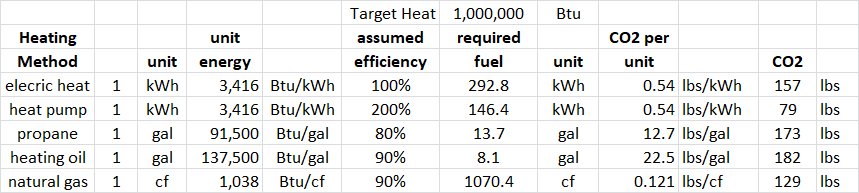
Here we consider five heating systems listed in the table below. The question is how much CO2 do they emit (directly, or indirectly) in producing 1,000,000 Btu of heat. The calculations are easily accomplished with a spread sheet, and are shown in the table below.
What the table shows is that the electric heat pump with COP = 2 (200% efficiency) has the lowest carbon footprint — again, using a conservative estimate of the carbon footprint for the Maine electric grid. The next lowest carbon footprint would be for a 90% efficient natural gas boiler or furnace. This option is not readily available in rural Maine. Resistive electric heat has double the footprint of the heat pumps, but using Maine electricity, still has lower carbon than propane or a system that uses home heating oil.
Bottom line, given the various heating systems available to me, my heat pumps have the lowest carbon footprint — at least with the assumptions I have used.
I must point out, however, that you could look at the carbon footprint of the electric grid differently. Maine’s electric grid is what it is. My adding the load of a heat pump to the existing grid means that the load goes up. How is that load met? Given the economics of power the grid is always using generators with the lowest marginal cost of operation. So renewables are being maxed out, as is hydro and nuclear. If you need more power at any point it is obtained by ramping up a natural gas peaking plant. So the argument could be made that additional load on the grid has the carbon footprint of a natural gas peaking plant — which is much higher than the carbon footprint.
Again, the basic argument is this. If I have an electric heater and I stop using it — this will lower the demand on the electric grid, and accordingly some plant that is supplying electric to the grid will be ramped down. The plant that is ramped down will be the one with the largest fuel cost (i.e., marginal cost of operation). It won’t be a wind turbine, hydroelectric, or solar because they have no fuel cost. The energy saved will be the natural gas that is not needed in a gas peaking plant. In other words, in thinking about the carbon footprint of an electric load we should not look at the average carbon content of the grid, but rather the carbon saved or used when the load is decreased or increased.
A natural gas peaking plant has an efficiency typically of 30-42%. Let’s just call this 36%. At 36% efficiency a peaking plant would need to burn 9.14 cf of natural gas, which then has a carbon footprint of 1.1 lbs. In other words, no matter how clean the overall electric supply is for Maine or any other region — the marginal change in carbon emission when you increase or decrease the electric demand is 1.1 lbs of CO2. I would argue that this figure of 1.1 lbs/kWh is the relevant metric to use for deciding whether to use electricity or a fossil fuel to produce heat.
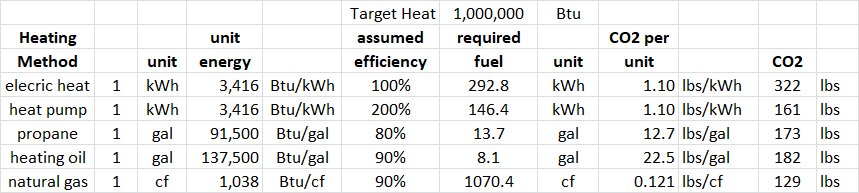
How do the above calculations change if this figure is used instead of the one used earlier (0.53 lbs/kWh)? With this carbon footprint for electricity, our Table above changes.
With this view, natural gas remains the best option for lowering carbon emission. The next best is the electric heat pump. Both propane and home heating oil still have higher carbon emission than an electric heat pump. The worst is resistive electric heat.
This view will not be popular — and many intelligent, committed advocates of sustainability will disagree. But I believe this is the correct way to think about this. Note that if the heating COP of the heat pump was higher — say 3 rather than 2 — then the heat pump would have a lower carbon footprint than any of the fossil fuel options — even when using electricity produced from burning natural gas in a peaking plant. And that would be the same in any state. Here in rural ME I don’t have the natural gas options — so even with COP = 2, the mini-split heat pump is my best option for lowering carbon.
I believe in just a few more years we will see new heat pump technology that does achieve a COP of 3 or higher over a wide range of operating temperatures. When that happens I will be a strong advocate of heat pumps — subject of course, to a cost/benefit analysis. This will be the subject of my next post.
After using Mitsubishi mini-split heat pumps in two houses for two winters I am finally prepared to share my conclusions on their operational cost and ability to maintain comfortable temperature. It will take a number of posts to unfold the details and nuances, and to compare heating costs with fossil fuel alternatives, but here are my main conclusions.
First, these heat pumps, using electricity purchased from Maine’s electric grid, have a lower carbon footprint than other forms of residential heat owing to the relatively low carbon footprint of Maine’s electric grid. This is the main reason electric heat pumps are being heavily promoted in New England, and from a public policy perspective, are achieving the important goal of lowering carbon emission.
Second, my Mitsubishi heat pumps were able to maintain reasonably comfortable inside temperatures (65-70oF) with the outside temperature as low as -5oF. During one extremely cold weekend (-15oF) the heat pumps struggled to keep my cottage above 50oF inside — but we did not fear freezing pipes and the extreme temperatures lasted just 1-2 days.
Third, on average, my mini-split heat pumps use about half as much energy as would electric baseboard heaters to accomplish the same task. That means they cost half as much to operate as electric resistive heat. In tech language, averaged over my winter conditions, the heat pumps demonstrated an effective heating COP = 2. These energy savings are meaningful but considerably lower than those advertised for these heat pumps which are said to have heating COP’s as high as 3.5. That may be true under certain conditions, but averaged through my heating season they are far less efficient.
The fourth conclusion is that temperature regulation and comfort delivered by my heat pumps, while acceptable, is inferior to that delivered by either my electric heat or propane through-the-wall heater. Even though the set points on the heat pumps remain constant, the indoor air temperature, measured by independent temperature sensors, show fluctuations in temperature in the range of plus/minus 1.5oF. These fluctuations are significantly larger than those experienced with other heaters and display an irregularity that is difficult to understand.
The fifth conclusion is that the cooling and dehumidification provided by these heat pumps is welcome in the summer. However, while providing a degree of comfort not afforded by other heating systems, it comes at the cost of additional electric use and greenhouse gas emission.
In the next few months I will be posting details to justify the above conclusions. In addition, I will discuss the capital investment required to install these heat pumps, and look at the cost-effectiveness of the electric savings delivered. An electric heat pump can be a cost effective way to both heat and cool a residential space. But it is not always the cost-effective solution, particularly if cooling is not required.
Last week I posted a graph of the Cottage daily electric use. This graph is updated every day. While the graph is very useful, it does not include any propane used. While there are many days that the cottage does not use propane, I do expect to use propane for heat this winter. And there were some days in November when propane was used to heat the cottage.
As I suggested earlier, propane and electric use can be included on a single graph of daily energy cost. Electric energy costs me $0.30/kWh in Maine and propane costs $4.29/gal. (I should point out that propane cost would be significantly lower if I used much more propane. My local supplier is currently charging $3.30 per gallon delivered for customers with 1000 gal annual use. So far my use is at the 100-200 gal/year level.)
This month (December) I am using propane heat much more in order to actually compare my propane flow numbers with the amount of propane that is delivered. I received a propane delivery about a week ago, so my goal is to use a significant amount of propane in the next few weeks so that I can use the next propane delivery to calibrate my propane flow meter.
I have performed a preliminary calibration of the propane flow meter — and that calibration is being used to produce the propane costs in the above graph. But I do expect to adjust these figures once I receive the next propane delivery.
Recall from my earlier post that, under conditions that my heat pump had a heating COP = 3.3, propane heat cost was about 2.2X the cost of heat from my heat pumps. So it is with great reluctance that I turn off the heat pumps and heat with propane. Such is the cost of scientific experiments.
A few weeks ago I noticed that the Mitsubishi mini-split heat pumps in my house were consuming considerably more electric energy than those in my guest cottage. This applied especially to the large heat pump (15 kBtu/h) in my house living room which carries the most load.
Since then I have looked at this more closely and concluded that the excessive energy use is assocated with the fan speed settings on the heat pumps. The fans on both house heat pumps were set to Auto while the ones in the cottage were set to High (setting 4 of 5 possible manual fan speed settings). When I switched the fan mode of the house heat pumps from Auto to High their energy consumption decreased by 30-50%. That is, they supplied more heat while using less electric energy. The change was substantial.
The data that support this conclusion are convincing. The first measurements I made were to determine the heating COP for the living room heat pump. I did this 3-4 times on different days with different outside temperatures. I obtained COP numbers like 1.95, 1.15, and 1.14. This concerned me so I reached out to my installer, Dave’s Appliance. They, in turn, told me they passed my information along to Mitsubishi. In the intervening two weeks I have not heard back from either.
I don’t know why but at some point I wondered if the fan setting might be involved. Both guest cottage and house were to be unoccupied for a few days so I set the heat pumps in both to maintain an interior temperature of 60oF, 24-hours-a-day. In addition I wrote a Home Assistant automation to change the fan speed setting at midnight so that I could observe the impact of this change on energy use. I performed this experiment with the 15 kBtu/h house living room heat pump and also with the 18 kBtu/h cottage heat pump. For both heat pumps I observed similar results. The heat pumps used 40-50% less power when the fan mode was set to High as compared to when the mode was set to Auto. I also determined that the heat pump used excess power when the fan mode was set to Medium (3rd of five manual settings). I did not try any of the slower fan settings. I have confirmed similar energy savings when the fan is set to Very High (5th of five manual settings). I believe that these conclusions apply to all four of my heat pumps, though the level of savings may vary.
After I changed the living room heat pump fan speed setting to High I again measured its heating COP. This time I obtained a value of 3.7 when the outside temperature was 30oF.
I should mention that each of my four heat pumps make use of the wireless remote temperature sensor sold by Mitsubishi. It can be purchased on Amazon. In principle, this should seemlessly integrate with my heat pumps.
This seems to me to be an important result. If I were not metering (and paying attention to) my heat pump energy I would not know they are not operating efficiently. They are producing heat and the room is comfortable. Heat pump energy use is not monitored for most installations.
But energy (and associated cost and carbon) savings is the only reason to invest in heat pumps rather than inexpensive electric baseboard heaters. After all, electric base board heaters provide more stable and quieter heat and are cheaper to install. If heat pump operation does not deliver the promised savings the heating costs and carbon footprint will not meet expectations. It is quite possible that thousands of heat pump installations in New England alone are using 50% more energy than necessary because their fans are set to Auto mode. It seems to me that Mitsubishi should care.
I don’t know if this problem is related to my use of remote wireless temperature sensors, or if it also would apply even using the internal temperature sensors. (I will not be able to disconnect my remote sensors in order to test this until I return to Maine after Christmas.) It is possible that Mitsubishi software that controls the fan may be written only for the internal tempearture sensors and is not approriate when connected to a wireless temperature sensor. I have seen nothing on the Mitsubishi web site that suggests this.
I should point out that when one uses either Kumo Cloud or the remote control to change settings on the heat pumps this often changes many other heat pump parameters. For instance, if you point the remote at the heat pump and raise the temperature, the remote also sends other parameters it has saved for fan speeds, direction, etc. Someone might set the heat pump fan speed to High using the Kumo Cloud phone app, then later adjust the set temperature with the remote and inadvertently change the fan (and other) settings to those saved on the remote.
One final comment. I did find that the temperature fluctuations were smaller when the fan was in Auto mode than when the fan was set to High or Very High. So there does seem to be a tradeoff between energy savings and temperature control. Experiments continue to better quantify this.
One of my students, Griffin O’Neal-Freeman, figured out how we can export data from Home Assistant to a Google Docs. This provides a useful gateway for posting our Home Assistant data on the web. Below is a graph showing the daily electric use of the Guest House for the month of December. The graph should be updated daily.
The same graph for November is shown below.
This graph only includes electric energy — it does not include propane. The main reason is that we have to figure out the best way to graph propane and electric energy on the same scale. One possible method is to use Btu — but should this be site energy or source energy? I am leaning towards making a graph where energy cost is the common metric. The propane presently costs me $4.29/gal while the electric is close to $0.30/kWh. (This is an average cost as the cost formula is complicated, beginning with a large monthly fee for just having a connection.)
In the last week or so the energy used by the Rheem HW heater has increased. That is because I switched it from heat pump mode to resistive electric heat. In response to recent rains and elevated outside temperature I ran the dehumidifier in the crawl space. This will not normally be running when the outside temperature is below 40F.
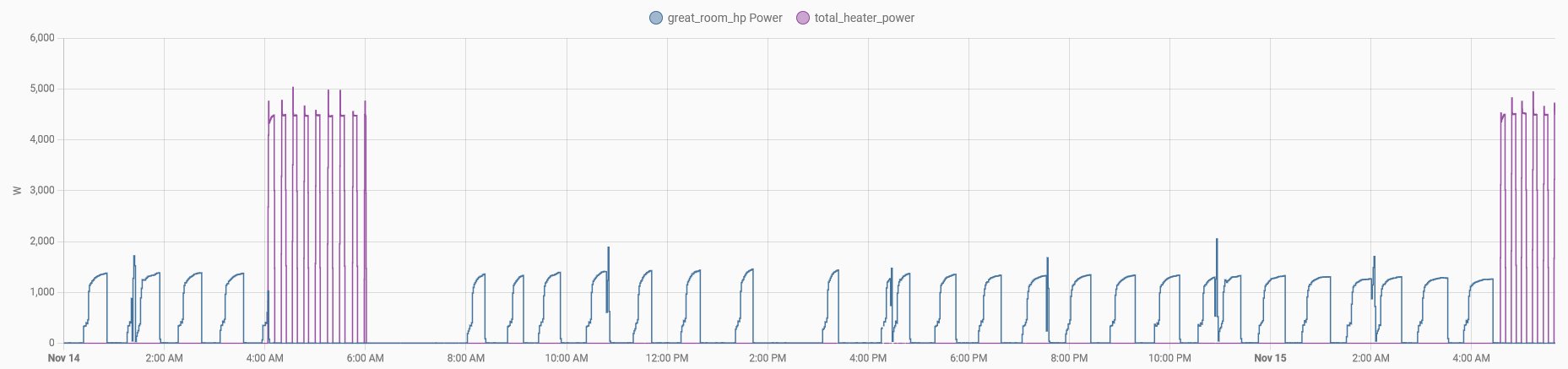
Nate Adams asked whether the heat pump was modulating its electric use to maintain temperature or cycling on and off? The power data (below) show it is cycling on and off.
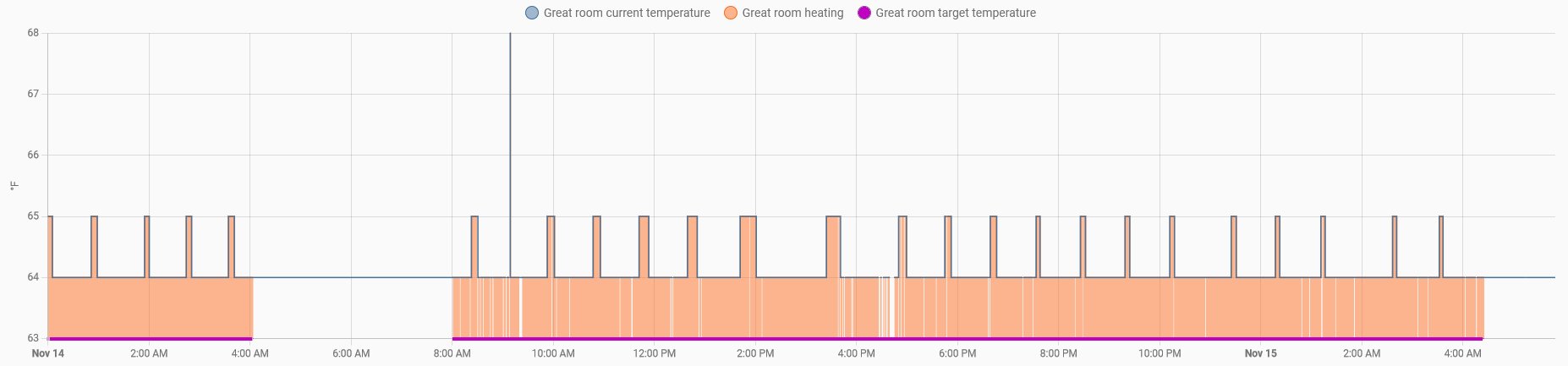
The graphs below are for the last 30 hours or so and overlap with some of the data I posted yesterday. They also include another night of heating with the 18 kBtu/h heat pump. The first graph is what Home Assistant gets from the Mitsubishi Kumo Cloud interface regarding the settings of the heat pump. The second graph is the Govee temperature data and the third is electric power from both the heat pump (blue) and the electric heaters (purple).
For most of this time I am heating with the heat pump. In early afternoon (2-4PM) solar gain through the windows causes the Govee temperature to rise above set point and the heat pump throttles back. The HP was turned off from 4-8AM yesterday to heat for 2 hours with electric then 2 hours with propane. The electric heater power data are shown in purple.
The first graph clearly shows that the set point (purple) is 63F while the measured temperature of the wireless sensor (blue) bounces between 64 and 65. I simply do not understand why the Mitsubishi control software maintains an average temperature above the set point.
As I have indicated, this heating season I will be using my guest house in Maine to study the energy performance of two Mitsubishi mini-split heat pumps. Already some interesting results are emerging. So far this season, with outside temperatures 23°F and above, the heat pumps demonstrate considerable energy (and cost) savings as compared with electric, baseboard heat. My students and I are starting to quantify the savings. Here I report on some preliminary results.
We have three ways to heat the guest house: 1) Two Mitsubishi mini-split heat pumps (one 6kBtu/h and the other 18kBtu/h), 2) A 20,000 Btu/h Rinnai propane vented wall furnace, and 3) three 1.5 kW ceramic electric heaters (together, 15,400 Btu/h) distributed throughout the open space. Each of these three systems has its own remote thermostat. The heat pumps each have a wireless remote thermostat mounted on the wall across the room. The Rinnai is controlled remotely by an Emerson Sensi thermostat, also wall-mounted across the room. And the three ceramic electric heaters are individually plugged into smart outlets that are controlled by Home Assistant using software to mimic a simple on/off thermostat, with temperature measured by a Govee WiFi thermometer sitting on a cabinet near the Sensi thermostat. Because the Govee thermometer reads in 0.1°F increments, it is the common metric used for determining the Cottage inside temperature.
My Home Assistant Heating Dashboard is shown below. All of the heating and monitoring systems can be remotely accessed.
Solar gain is a big factor during the day, so our heating experiments are conducted at night. Last night we heated the guest house for several hours using three of the four heating systems (just used one heat pump). The results are shown below. The first graph shows the Govee temperature from 4 PM yesterday through 10 AM this morning (11/14). Until 4 AM space temperature was maintained by the 18 kBtu/h heat pump. Early yesterday the set point for the heat pump was 65°F but was lowered to 63°F around 6:40 PM yesterday. At 4 AM the heat pump was turned off and the interior temperature was maintained for the next two hours with the three 1.5 kW electric heaters. At 6 AM heat switched from electric to propane. Both the propane and electric heat had set temperatures of 64°F. At 8 AM the propane heat was terminated and control was given back to the 18 kBtu/h heat pump.
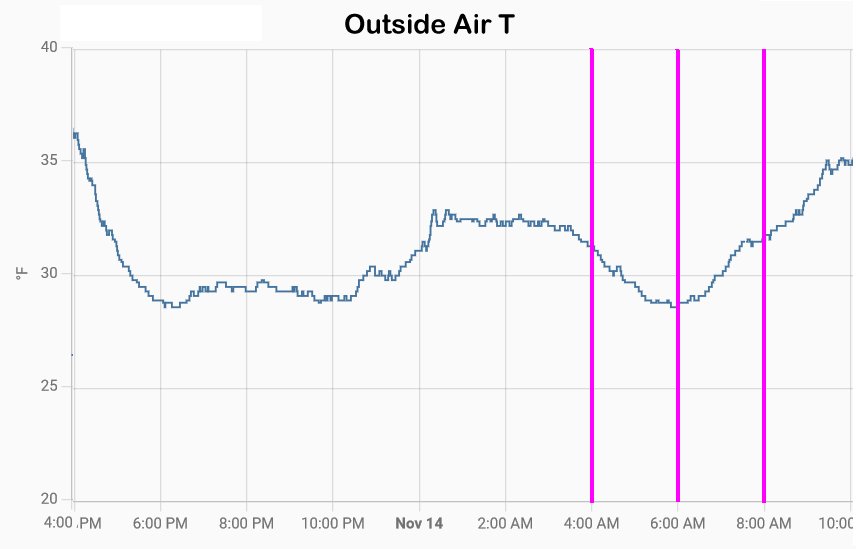
The outside temperature, measured with our Ambient weather station is graphed below. The purple lines indicate when the heating system was changed. From midnight on the outside temperature stayed within 2°F of an average value of about 31°F.
The electric power to the heat pump and the electric heaters were continuously monitored. The average electric power to the heat pump between midnight and 4 AM was 553 Watts. From 4AM to 6AM the electric heaters had an average power of 1830 Watts. That is, the electric heaters used 3.3X the power used by the heat pump. Without adjusting for the change in outside temperature this implies a heating COP = 3.3. This is great news. It means 3.3X lower heating cost than with electric resistive baseboard heat.
But there seems to be a small price to pay for this energy savings. The temperature regulation with the heat pump is not nearly as good as with either of the other two heating systems. The heat pump caused temperature swings of about 2°F while the other two systems have swings of only 1/5th this amount. Moreover, the average temperature maintained by the heat pump is well above its 63°F set point. (Even when you graph the temperature determined by the heat pump’s remote wireless sensor you see that it is always above the set point.) One has to wonder why the control software for the heat pump is not able to do a better job of maintaining the desired temperature. There appears to be no ability to change the “deadband.” for this unit.
We are still working on metering the propane flow in order to understand the energy use for the propane heater. We hope to have this metered soon, it has proven more difficult than we imagined.
But even without metering the propane, I know how much propane should have been burned from 6 – 8AM. From 4-6 AM the electric heaters provided 1.830kW x 2 h = 3.7 kWh of heat. I am paying $0.30/kWh for electric so my cost for this electric is $1.10. 3.7 kWh of energy is equivalent to 12,500 Btu. My propane furnace is rated at 80% efficiency. So to deliver this amount of heat requires that it burn 15,600 Btu of propane. The energy content of a gallon of propane is 91,452 Btu. So I would have had to burn 0.171 gal of propane which, at a cost of $4.29 per gallon, would cost me $0.73.
Hence, 2 hours of heat last night cost me $1.10 using electric heat, $0.73 using propane, and $110/3.3 = $0.33 using the electric heat pump, this with an outside temperature of nearly freezing. The only downside of the heat pump is the lack of temperature control. I am optimistic, however, that we can learn how to use the heat pump better to achieve better control.
One final thing to note is that when I look at the specs for this Mitsubishi compressor, MUZ-FS18N it appears to me that for a wet-bulb outside temperature of about 30°F and a dry-bulb inside temperature of 65°F the heating COP should be 3.21, consistent with my measurement of 3.3.



 The Pragmatic Steward