Unknown's avatar

About The Pragmatic Steward

Professor of Physics at Oberlin College. I was originally trained as a condensed matter experimentalist. In the last 15 years my research has focused on photovoltaic devices, PV arrays, wind energy, energy efficiency, and energy use in buildings.

Another look at the analysis by Pollock and Rosiak

A few months ago I called attention the Washington Examiner article by Richard Pollock and Luke Rosiak.  On first read it provided more evidence confirming a trend I have seen in several data sets — that LEED-certified buildings, on average, are not saving primary energy — in this particular case, as measured by ENERGY STAR scores.

But 24 hours later I pulled my original post.  I am not convinced that this cursory study is sufficiently rigorous to stand up to scrutiny.  There are two key reasons for my skepticism.  The first is that over the last year I have leaned that the EPA’s ENERGY STAR building rating system is built on a “house of cards.”  It may encourage building energy efficiency, but it is not founded on good science and there is little reason to believe that a higher ENERGY SCORE means a more energy efficient building.

The second reason is more complicated.  Comparing the energy use of one group of buildings with another is actually difficult to do correctly.  Several of my papers have concluded that other researchers have gotten it wrong in the past.  It is certainly not an activity to be left to people who begin the study with a stake in the outcome — either those promoting LEED or those “dug in against it.”  And, despite the publicity surrounding Thomas Frank’s study in USA Today, it is an activity best left to building professionals and researchers — not reporters.

In this particular case it appears to me that many of the buildings identified by Pollock and Rosiak as “LEED buildings” are not actually LEED-certified at all — they are mostly LEED registered projects.  Anyone can “register” a LEED project — simply stating intentions and requiring a modest fee.  But only minority of those projects that register actually see the process to completion and become LEED-certified.  As critical as I have been of the USGBC’s past claims about energy savings — I cannot hold the USGBC responsible for energy consumption of buildings that have never completed LEED certification. Maybe the registered LEED buildings in this article will soon complete certification.  If and when that occurs then we should look at their subsequent performance.

Washington DC has just released benchmarking data for all its large commercial buildings.  One of my students is in the process of parsing this list to identify LEED and ENERGY STAR certified buildings.  The goal will then be to compare the performance of LEED certified buildings with other buildings.  Only then can we draw any conclusions.

USGBC Continues to “cherry pick” LEED energy data

At the 2007 GreenBuild Conference the USGBC released the results of their first major study of energy consumption by LEED-certified buildings.  Then they presented conclusions from the now infamous study conducted by the New Buildings Institute (paid for by the USGBC and EPA) which, based on data “volunteered by willing building owners” for only 22% of the eligible buildings certified under LEED NC v.2, concluded that LEED certified buildings, on average, were demonstrating the anticipated 25-30% savings in (site) energy.

NBI’s analysis and conclusions were subsequently discredited in the popular media by Henry Gifford and in the peer-reviewed literature by me [see IEPEC 2008 and Energy & Buildings 2009].  NBI’s analytical errors included:

  1. comparing the median of one energy distribution to the mean of another;
  2. comparing energy used by a medium energy subset of LEED buildings with that used by all US commercial buildings (which included types of buildings removed from the LEED set);
  3. improper calculation of the mean (site) energy intensity for LEED buildings and comparing this with the gross mean energy intensity from CBECS;
  4. NBI looked only at building energy used on site (i.e., site EUI) rather than on- and off-site energy use (i.e., source EUI).

To NBI’s credit they made their summary data available to others for independent analysis with no “strings attached.”  In the end even the data gathered by NBI, skewed towards the “better performing” LEED buildings by the method for gathering data, when properly analyzed demonstrated no source energy savings by LEED buildings.  LEED office buildings demonstrated site energy savings of 15-17% — about half that claimed by NBI, the difference being associated with NBI’s improper averaging method.  This site energy savings did not translate into a source energy savings because LEED buildings, on average,  used relatively more electric energy, and the off-site losses associated with this increased electric use wiped out the on-site energy savings.

The lack of representative building energy data was addressed in LEED v.3 (2009) by instituting a requirement that all LEED certified buildings supply the USGBC with annual energy consumption data for five years following certification.  Never again would the USGBC have to publish conclusions based on data volunteered by 1 in 5 buildings.  Expectations were high.

But what has this produced?  The USGBC has learned from their experience with NBI — not to hand over such an important task to an outside organization because you can’t control the outcome.  NBI’s analysis was scientifically flawed — but it was transparent, and such transparency gave critics ammunition to reach different conclusions.  Nowadays the USGBC simply issues carefully packaged sound bites without supplying any details to support their conclusions.  There isn’t even a pretense of conducting scientifically valid analysis.

Consider the most recent claims made by the USGBC at the 2013 Greenbuild conference, summarized by Tristan Roberts in “LEED buildings above average in latest energy data release.”  Roberts asserts the following:

  1. The USGBC has received energy data from 1,861 certified buildings for the 12-mos period July 2012 – June 2013;
  2. About 70% of these were certified through LEED-EBOM (existing buildings);
  3. 450 of these buildings reported their data through the EPA’s Portfolio Manager;
  4. the “building-weighted” (or un-weighted) average source EUI for these 450 buildings is 158 kBtu/sf;
  5. this average is 31% lower than the national median source EUI;
  6. 404 (of the 450) buildings above were eligible for (and received) ENERGY STAR scores;
  7. the average ENERGY STAR score for these 404 buildings was 85.

In addressing the above claims it is hard to know where to begin.  Let’s start with the fact that the USGBC only provides energy information for 450 (or 24%) of the 1,861 buildings for which it has gathered data.  Is this simply due to the fact that it is easier to summarize data gathered by Portfolio Manager than data collected manually?  If so I willingly volunteer my services to go through the data from all 1,861 buildings so that we can get a full picture of LEED building energy performance — not just a snapshot of 24% of the buildings which “self-select themselves” to benchmark through Portfolio Manager.  (The EPA has previously asserted that buildings that benchmark through Portfolio manager tend to be skewed towards “better performing” buildings and are not a random snapshot of commercial buildings.)

Next, consider the “un-weighted” source EUI figure for the 450 buildings.  This is a useless metric.  All EUI reported by CBECS for sets of buildings are “gross energy intensities” equivalent to the gsf-weighted mean EUI (not the un-weighted or building-weighted mean EUI).  This was a major source of error in the 2008 NBI report — leading NBI to incorrectly calculate a 25-30% site energy savings rather than the actual 15-17% site energy savings achieved by that set of LEED buildings.

Consider the assertion that the 158 kBtu/sf source EUI figure is 31% lower than the median source EUI (presumably for all US commercial buildings).  To be correct this would require the median source EUI for all US commercial buildings be 229 kBtu/sf.  This is rubbish.  The best way to obtain such a median EUI figure is from the 2003 CBECS data.  The Energy Information Administration (EIA) does not report source energy figures in any of its CBECS reports.  But the EIA does report site and primary electric energy used by buildings, and these may be combined to calculate source EUI for all 2003 CBECS sampled buildings.  This results in a median source EUI for the estimated 4.9 million commercial buildings to be 118 kBtu/sf.  If you instead restrict this calculation to all buildings with non-zero energy consumption you find these estimated 4.6 million buildings have a median source EUI of 127 kBtu/sf — way below the 229 kBtu/sf figure asserted by the USGBC.  This USGBC claim is patently false.  Of course the USGBC may be referring to the median source EUI of some unspecified subset of U.S. buildings.  By choosing an arbitrary subset you can justify any claim.  And if you don’t specify the subset — well, the claim is nothing more than noise.

What about the average ENERGY STAR score of 85?  Is this impressive?  The answer is no.  Even if you believed that ENERGY STAR scores were, themselves, meaningful, such an average would still mean nothing.  ENERGY STAR scores are supposed to represent percentile rankings in the U.S. building population.  Since there are 4.8 million buildings, by definition we would expect 10% of these (or 480,000) to rank in the top 10% and we would expect another 480,000 of these to rank in the bottom 10%.  That means that if 1,861 buildings are chosen at random from the building population, we expect 10% of these to have ENERGY STAR scores from 91-100.  Similarly, we expect 30% of these (or 558) to have ENERGY STAR scores ranging from 71-100.  Guess what — the average ENERGY STAR scores of these 558 buildings is expected to be 85.  Only those who are mathematically challenged should be impressed that the USGBC has found 404 buildings in its set of 1,861 that have an average ENERGY STAR score of 85.  If you cherry pick your data you can demonstrate any conclusion you like.

And, of course, these 1,861 buildings are not chosen at random — they represent buildings whose owners have a demonstrated interest in energy efficiency apart from LEED.  I would guess that the vast majority of the 404 buildings were certified under the EBOM program and have used Portfolio Manager to benchmark their buildings long before they ever registered for LEED.  LEED certification is just another trophy to be added to their portfolio.  No doubt their ENERGY STAR scores in previous years were much higher than 50 already.  What was the value added by LEED?

I openly offer my services to analyze the USGBC energy data in an unbiased way to accurately asses the collective site and source energy savings by these LEED buildings.  How about it Brendan Owens (VP of technical development for USGBC) — do you have enough confidence in your data to take the challenge?  Which is more important to you, protecting the LEED brand or scientific truth?
ENERGY STAR energy benchmarking is not ready for prime time

I recently had occasion to read an old paper by Janda and Brodsky describing the “first class” of ENERGY STAR certified office buildings.  This is one of only a handful of papers in the peer-reviewed literature regarding ENERGY STAR building scores.  Janda and Brodsky describe the brand name ENERGY STAR as

a set of voluntary partnerships between the U.S. government and product manufacturers, local utilities, home builders, retailers, and businesses.  These partnerships are designed to encourage energy efficiency in products, appliances, homes, offices, and other buildings.

This was the basis for the EPA’s building ENERGY STAR scoring system.  It was a “game” that building managers voluntarily agreed to play with rules (methodology for scoring buildings) set by the EPA in consultation with those playing the game.  There was no scientific vetting of the “rules of the game” — nor did there need to be — it was just a game designed to “encourage energy efficiency.”  No one was forced to play the game.  Data submitted to Portfolio Manager (the EPA’s web-based tool for calculating scores) and ENERGY STAR scores issued by the EPA were confidential — unless a building sought and received ENERGY STAR certification.  Participation was entirely voluntary.  Building managers disappointed with their ENERGY STAR scores could just walk away from the game — no harm, no foul.

But this has all changed.  In recent years 1) the EPA has published specific claims regarding energy savings associated with its ENERGY STAR benchmarking program (real savings not just fantasy football), 2) external organizations like the USGBC have adopted the ENERGY STAR score as their metric for energy efficiency in green building certification programs and are using these scores to make energy savings claims of their own, and 3) major U.S. cities have passed laws requiring commercial building owners to use Portfolio Manager to benchmark their buildings and, in many cases, the resulting ENERGY STAR scores are being made public.  With federal, state, and local governments requiring LEED certification for public buildings this is no longer a voluntary game — it is mandatory and real (testable) energy claims are being made based upon ENERGY STAR scores.  Now the science behind such claims actually matters — and this science has never been vetted.

Its kinda like a small, “mom and pop” operation that has been selling chicken soup using “grandma’s recipe” without obtaining proper license or FDA approval.  Now imagine Walmart decides to market and sell the soup — the scrutiny changes.

As a voluntary game with no connection to reality it is OK that the EPA negotiates rules for its ENERGY STAR ratings with different constituents — like allowing Washington DC office buildings to ignore their “first floors” in seeking ENERGY STAR certification.  After all, who am I to interfere in the activities between consenting adults when these activities do not affect me?  But for ENERGY STAR — these days are gone.

In the next year we will learn much about the science that underpins the EPA’s ENERGY STAR benchmarking system — and the results are likely to be very disappointing.  This benchmarking system is not ready for prime time.

Hero Stories and Learning Stories

Kathryn Janda and Marina Topouzi published an interesting paper at the 2013 Summer Study on Energy Efficiency sponsored by the European Council for an Energy Efficient Economy (ECEEE).  The title of their paper is “Closing the loop: using hero stories and learning stories to remake energy policy.”  Kathryn Janda spent a few years on the faculty at Oberlin College and refers to the College’s “trophy building” — the Adam Joseph Lewis Center as one of her examples.

Janda and Topouzi argue that “hero stories” describe something that is bigger than life and not realistic.  They draw parallels with narratives offered for energy efficient buildings and projects — the “stories” or claims are unrealistic and, all too-often, reality falls short of the promise.  In the end they argue that there is an interesting “learning story” in the reality — one that is all too-frequently left untold.

The paper is interesting and well-written — not at all like most scientific papers.  Rather than provide a poor summary of their paper let me provide this quotation from their abstract:

This hero story, where we are saved by clever technologies, is inspiring, positive, and familiar. In this story, we don’t need to do anything because the technology will do it for us. But how real is it? The counterpart to the hero story is the learning story, where things are not quite as simple as they first seemed. In a learning story, protagonists are normal people who need to rise to a challenge. They are not saved by Superman, they have to save themselves. The learning story in energy policy lies in the between the technical potential and what is achieved in practice.

The piece is a refreshing read.

Pertamina Energy Tower to generate all its energy — really?

Fast Company has a short article by Adele Peters that describes some design features for the 99-story Pertamina Energy Tower that is planned for construction in Jakarta.
The building, designed by Skidmore, Owings & Merrill, will be the “first supertall tower in the world to generate its own power” apparently by capturing wind power at the top of the building and sucking geothermal from the bottom.  Excuse me if I am a bit skeptical.

3023870-inline-pertamina-energy-tower1tower-from-roundaboutsom

Flash back 15 years to a different architect — William McDonough — whose firm designed the Oberlin College’s Adam Joseph Lewis Center.  Bill is the standard bearer for architects that make fantastic claims backed up by little substance [Green guru gone wrong – Fast Company].  This success requires a media willing to publish such claims years before we ever see the fruit of the work.  When the fruit finally arrives — shriveled and disappointing — it matters little because the architect has moved on.

Consider Oberlin College’s Adam Joseph Lewis Environmental Center.  Long before its construction in 2000 McDonough was claiming he had designed a zero energy building — one that would be powered by solar cells mounted on its roof.  Through the years his claims never wavered.  Never mind that, following construction, the building consumed three times the energy his firm claimed it would [Early performance of a green academic building – ASHRAE] or that years later, after hundreds of thousands of dollars of HVAC modifications, it consumed double his initial projections — less than half the energy provided by its rooftop array.  Now, after 12 years of false claims the building has finally moved “into the black” powered by a $1,000,000 PV array constructed over a nearby parking lot which, combined with its $400,000 rooftop array, produces 3X as much energy as the the design team projected for the building.  [A paler shade of green – HPAC Mag]  I wonder how much attention McDonough would have gotten in 1998 had he told the world that he had designed, at a cost of $500/sf, a 14,000 sf building that used 20% less energy than conventional buildings and was to be powered by PV panels covering its roof and a parking lot, costing $1,400,000.  (That is an additional $100/sf just for the solar arrays.)  Excuse me Mr. McDonough — what was your “value added” — publicity?

But this post is about another project — the Pertamina Energy Tower.  My point is this.  Talk is cheap.  There is little doubt that this building will not deliver on its promises.  But for now the architects can spin their exciting story to media who don’t ask the hard questions — like “wouldn’t a shorter, fatter building be cheaper and use less energy? Or, “how much rental space is lost to provide space for the wind turbines and what is the cost/benefit of this?”  Physicists are good at “back of the envelope” calculations.  A 99-story building seems like an expensive way to mount a wind turbine.

NYC LEED Office buildings underperform for second year straight

In September 2012 NYC released public data for its first year (2011) of energy benchmarking for large (> 50,000 sf) commercial buildings.  This list included data for roughly 1,000 office/financial buildings.  (Note that the EPA ENERGY STAR building rating system makes no distinction between large office buildings and financial centers — henceforth referred to as office buildings.)  These data were cross-listed with the USGBC LEED project database to identify a subset of 21 LEED office buildings (totaling 24.5 million sf) that were certified before 2011 in one of three LEED programs that should impact energy consumption and green house gas emission — New Construction (NC), Existing Buildings (EB) and Core & Shell (CS).  The energy consumption and GHG emission of these LEED-certified buildings were compared to those for other NYC office buildings and found to be unremarkable.  Specifically, LEED certified office buildings showed no reduction in GHG emission or energy consumption as compared with other NYC office buildings.  This work was summarized previously.  The peer-reviewed publication detailing this work, “Efficacy of LEED-certification in reducing energy consumption and greenhouse gas emission for large New York City office buildings” is published this month in Buildings and Energy Journal.

In October this year NYC released a second year of benchmarking data (2012).  This year’s public disclosure includes buildings classified as condominiums (exempted last year) such as the New York Times building (with two owners).  The question arises — how are LEED-certified office buildings doing in year two?  For 2012 we can now include LEED buildings certified in 2011 (buildings excluded from those studies last year because they were not certified for the entire 2011 year for which energy data were gathered) — in principal yielding an even larger set of LEED-certified buildings.

The 2012 NYC benchmarking data includes energy and GHG emission data for 32 large LEED-certified office buildings (totaling 37 million sf).  Collectively these buildings have a gross (weather normalized) source energy use intensity (EUI) of 252 kBtu/sf and a gross site EUI of 104 kBtu/sf.  There GHG emission collectively is 8.9 kg/sf of CO2.  However, the means are skewed by the inclusion of just one building — the Bank of America Tower. This building was also omitted from the previous analysis of 2011 LEED office data.  Omitting this “energy-guzzler” the remaining 31 LEED certified office buildings have a gross (weather normalized) source energy EUI of 245 kBtu/sf and a gross site EUI of 98 kBtu/sf.

When you compare these numbers with the 2011 data for the 21 LEED buildings included in last year’s study you find that, this year, LEED office buildings showed 8% reduction in site energy, 7% reduction in source energy, and 9% reduction in GHG emission.  But are these changes significant and, if so, is this progress to be credited to the LEED buildings?

It turns out that all of these reductions are significant, though probably not at the 95% confidence level (have not completed that calculation).  The uncertainties in the gross site and source EUI for LEED buildings is 6% which means these reductions are slightly higher than “the noise.”

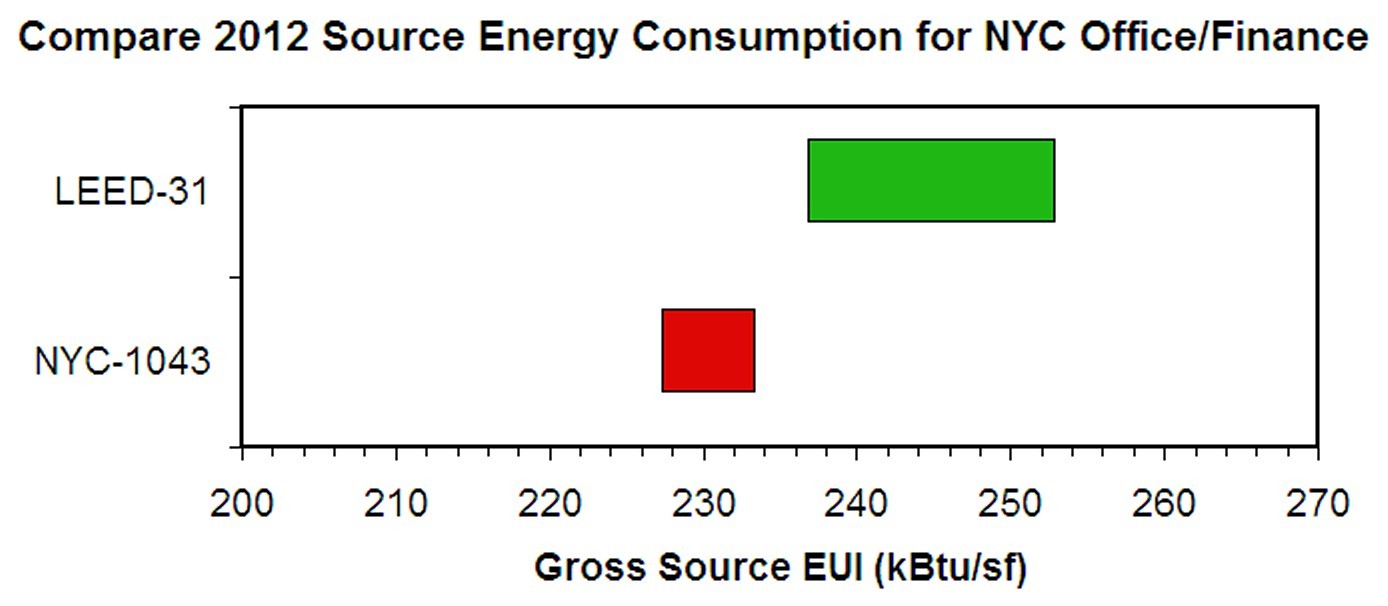
To determine whether these reductions are to be credited to the LEED buildings we need to look at similar numbers for conventional NYC office buildings.  The 2012 gross site and source EUI for the roughly 1,000 NYC office buildings are 92 and 230 kBtu/sf, respectively.  Comparing these to the energy data for the LEED offices we see that in 2012 LEED buildings used 7% more site energy and 6% more source energy than did conventional office buildings (on a per sf basis, of course).  Comparing their gross GHG intensities for 2012 we see that the 32 LEED certified office buildings are responsible for 8% more GHG emissions than conventional NYC office buildings.  The source EUI for the two building sets are compared in the figure below.

Compare LEED31 with NYC1043 Source

Bottom line, for the second year in a row LEED-certified NYC office buildings show no energy or GHG savings as compared with other NYC office buildings.  In fact they use more energy and emit more GHG than other NYC office buildings (on a per sf basis, of course).  These differences are more statistically significant than those between the LEED 2012 and 2011 performances — but need to be nailed down with further calculations.

When you compare the 2012 energy and GHG performance of all NYC office buildings with their performances in 2011 we an average decrease in Site EUI, Source EUI, and GHG emission of 11%, 10%, and 8% respectively.  In other words, the 2012 improvement in LEED performance simply tracks that for other NYC office buildings.  As they say, “all boats rise with the tide” — or in this case, go down with the tide.

The good news out of the 2012 Energy Benchmarking data is that all NYC office buildings made progress in lowering their GHG emission.  This is likely associated with the steady replacement of coal with natural gas at electric generating plants.  The abundance of natural gas released by fracking is most definitely lowering the carbon content of NYC’s electric supply.  A recent article by Alexis Madrigal describes greater advances yet to come in this area.

There is one more interesting fact about LEED office buildings included in the 2012 NYC benchmarking data.  Five of the 21 LEED office buildings who reported 2011 benchmarking data (the basis for my earlier study) are noticeably missing in the 2012 public benchmarking disclosure.  That means that these five building owners either 1) elected to pay the modest fine to NYC for failure to comply with LL84 or 2) have convinced the city to exempt them from mandatory benchmarking.  Either way this does not bode well for the future of energy transparency.  The USGBC has been collecting annual energy data for buildings certified under its v2009 and later yet publishes none of these data — only selected statistics as part of its marketing literature.  I think we all know what it means when someone invokes the “fifth amendment” and refuses to testify.  The same applies here to refusal to disclose energy data.  It is a good be that owners of really efficient buildings are not refusing to disclose their data.

I should also mention that Luke Rosiak of has published an article in the Washington Examiner regarding what the 2012 NYC Energy Benchmarking data have to say about the performance of LEED buildings as compared to other NYC buildings.  He focuses on Site EUI (rather than Source EUI) and also looks at the relationship between the number of LEED points awarded and Site EUI.  He finds negative correlation — in other words, the buildings that score higher LEED points tend to use relatively more site energy!

A special thanks to Oberlin College student Marisa Aikins for doing most of the work in cross-listing the NYC 2012 benchmarking data with the LEED project database.

Another look at fracking

Deroy Murdock has published an article entitled “Greener than ‘green’” in the National Review that compares several environmental impacts of fracking with those for several popular renewable energy sources.  I strongly recommend the article.

Just one area of interest is the amount of water used per unit energy.  Mr. Murdock claims it typically takes three gallons of water per million Btu of energy from fracking natural gas as compared with 11 gallons for nuclear power, 23 gallons for coal, and 15,800 gallons for corn ethanol.

The article is worth the read.

Bank of America Tower uses 20% more energy than projected

Sam Roudman’s New Republic article about the Bank of America building in NYC has stimulated much discussion about how we look at energy efficiency of a building.  The 2011 Energy Benchmarking data released by NYC showed that this Platinum LEED-certified building had one of the highest source energy intensities of all NYC office buildings – 363 kBtu/sf.  NYC has just released 2012 benchmarking data which has this figure at 358 kBtu/sf for 2012.  Detractors call it an energy guzzler — supporters say you cannot hold the USGBC or building owner (or building) responsible for the high energy demands of the trading floors run by the building occupants.  I cannot add to this debate — it will continue.

But there is another important issue that needs to be addressed.  The energy used by the Bank of America Tower is 20% higher than was predicted by its designers in 2010.  At that time the designers claimed the source EUI would be 306 kBtu/sf.  That figure, they said, was 14% lower than the baseline case.  But actual source energy use is 20% higher than projected — even higher than the baseline case!  Why were designers 20% off?  Surely they must have been aware of the intended use of the building.  The trading floors and their 5-monitor work stations could not have been a surprise.

Unfortunately this is common scenario — building energy projections that are significantly lower than measured consumption.  The design teams always claim the building use was different than intended — they couldn’t anticipate the changes.  It all sounds so hollow.

So long as LEED certification is based on such projections rather than actual consumption it will not produce the desired energy performance.  The loop needs to be closed.

The EPA doesn’t know the basis for its own ENERGY STAR building model

The US Environmental Protection Agency (EPA) issues ENERGY STAR building ratings for 11 different kinds of commercial buildings.  The so-called Technical Methodology for each of these building ratings is described in documents posted on the EPA web site.  Presumably anyone can work through the details of these technical documents to duplicate the EPA’s methodology.

But this is not the case for one of the models — that for Medical Office buildings.  If you follow the instructions set forth in the EPA’s document for extracting the building records from the 1999 CBECS on which this model is based you do not obtain the list of 82 buildings the EPA claims are the basis for this model.  Instead you obtain a list of 71 buildings.  Furthermore, if you calculate the mean properties of this set of 71 buildings you do not obtain those published by the EPA for this building set.  And finally, if you perform the regression the EPA says it has applied to these buildings you obtain different results than those published by the EPA.  In short, it is clear that the EPA’s Technical Methodology document for Medical Offices does not correctly describe their model.

I have petitioned the EPA through the Freedom of Information Act to supply the list of CBECS 1999 building ID’s that are used this model (EPA-HQ-2013-009270).   The EPA has responded that it does not have this list.  This means that the EPA not only has incorrectly described its own Medical Office model — it does not even know what the basis for this model is!  Its document describing the Technical Methodology for this model is fiction — just like the ENERGY STAR scores the EPA hands out for Medical Office buildings.

EPA Announces Carbon Emission Regulations for new Power Plants

Apparently the EPA has decided to move forward under its own authority to regulate carbon emissions for new power plants — according to an article in yesterday’s New York Times.  The emission standards are said to be 1000 lbs CO2 or new natural gas plants and 1100 lbs CO2 for new coal plants, both per MWh (1000 kWh) of electricity generated.

If you work through the numbers for natural gas that mean that the natural gas plant must be 40% efficient.  This is more efficient than many existing peaking generators in the midwest, but certainly attainable with current technology.  Therefore I think this is a reasonable standard for new natural gas plants.

But new coal plants will not be able to attain this standard through efficiency — they instead will have to capture and store CO2 — and frankly such technology is not demonstrated and available at this level.  Therefore this standard essentially means that no new coal plants will be able to meet the standard for many years to come.

More worrisome is what will be next for existing natural gas and coal plants.  How many years before the EPA extends these regulations to existing plants?