ENERGY STAR energy benchmarking is not ready for prime time

I recently had occasion to read an old paper by Janda and Brodsky describing the “first class” of ENERGY STAR certified office buildings.  This is one of only a handful of papers in the peer-reviewed literature regarding ENERGY STAR building scores.  Janda and Brodsky describe the brand name ENERGY STAR as

a set of voluntary partnerships between the U.S. government and product manufacturers, local utilities, home builders, retailers, and businesses.  These partnerships are designed to encourage energy efficiency in products, appliances, homes, offices, and other buildings.

This was the basis for the EPA’s building ENERGY STAR scoring system.  It was a “game” that building managers voluntarily agreed to play with rules (methodology for scoring buildings) set by the EPA in consultation with those playing the game.  There was no scientific vetting of the “rules of the game” — nor did there need to be — it was just a game designed to “encourage energy efficiency.”  No one was forced to play the game.  Data submitted to Portfolio Manager (the EPA’s web-based tool for calculating scores) and ENERGY STAR scores issued by the EPA were confidential — unless a building sought and received ENERGY STAR certification.  Participation was entirely voluntary.  Building managers disappointed with their ENERGY STAR scores could just walk away from the game — no harm, no foul.

But this has all changed.  In recent years 1) the EPA has published specific claims regarding energy savings associated with its ENERGY STAR benchmarking program (real savings not just fantasy football), 2) external organizations like the USGBC have adopted the ENERGY STAR score as their metric for energy efficiency in green building certification programs and are using these scores to make energy savings claims of their own, and 3) major U.S. cities have passed laws requiring commercial building owners to use Portfolio Manager to benchmark their buildings and, in many cases, the resulting ENERGY STAR scores are being made public.  With federal, state, and local governments requiring LEED certification for public buildings this is no longer a voluntary game — it is mandatory and real (testable) energy claims are being made based upon ENERGY STAR scores.  Now the science behind such claims actually matters — and this science has never been vetted.

Its kinda like a small, “mom and pop” operation that has been selling chicken soup using “grandma’s recipe” without obtaining proper license or FDA approval.  Now imagine Walmart decides to market and sell the soup — the scrutiny changes.

As a voluntary game with no connection to reality it is OK that the EPA negotiates rules for its ENERGY STAR ratings with different constituents — like allowing Washington DC office buildings to ignore their “first floors” in seeking ENERGY STAR certification.  After all, who am I to interfere in the activities between consenting adults when these activities do not affect me?  But for ENERGY STAR — these days are gone.

In the next year we will learn much about the science that underpins the EPA’s ENERGY STAR benchmarking system — and the results are likely to be very disappointing.  This benchmarking system is not ready for prime time.

Hero Stories and Learning Stories

Kathryn Janda and Marina Topouzi published an interesting paper at the 2013 Summer Study on Energy Efficiency sponsored by the European Council for an Energy Efficient Economy (ECEEE).  The title of their paper is “Closing the loop: using hero stories and learning stories to remake energy policy.”  Kathryn Janda spent a few years on the faculty at Oberlin College and refers to the College’s “trophy building” — the Adam Joseph Lewis Center as one of her examples.

Janda and Topouzi argue that “hero stories” describe something that is bigger than life and not realistic.  They draw parallels with narratives offered for energy efficient buildings and projects — the “stories” or claims are unrealistic and, all too-often, reality falls short of the promise.  In the end they argue that there is an interesting “learning story” in the reality — one that is all too-frequently left untold.

The paper is interesting and well-written — not at all like most scientific papers.  Rather than provide a poor summary of their paper let me provide this quotation from their abstract:

This hero story, where we are saved by clever technologies, is inspiring, positive, and familiar. In this story, we don’t need to do anything because the technology will do it for us. But how real is it? The counterpart to the hero story is the learning story, where things are not quite as simple as they first seemed. In a learning story, protagonists are normal people who need to rise to a challenge. They are not saved by Superman, they have to save themselves. The learning story in energy policy lies in the between the technical potential and what is achieved in practice.

The piece is a refreshing read.

Pertamina Energy Tower to generate all its energy — really?

Fast Company has a short article by Adele Peters that describes some design features for the 99-story Pertamina Energy Tower that is planned for construction in Jakarta.
The building, designed by Skidmore, Owings & Merrill, will be the “first supertall tower in the world to generate its own power” apparently by capturing wind power at the top of the building and sucking geothermal from the bottom.  Excuse me if I am a bit skeptical.

3023870-inline-pertamina-energy-tower1tower-from-roundaboutsom

Flash back 15 years to a different architect — William McDonough — whose firm designed the Oberlin College’s Adam Joseph Lewis Center.  Bill is the standard bearer for architects that make fantastic claims backed up by little substance [Green guru gone wrong – Fast Company].  This success requires a media willing to publish such claims years before we ever see the fruit of the work.  When the fruit finally arrives — shriveled and disappointing — it matters little because the architect has moved on.

Consider Oberlin College’s Adam Joseph Lewis Environmental Center.  Long before its construction in 2000 McDonough was claiming he had designed a zero energy building — one that would be powered by solar cells mounted on its roof.  Through the years his claims never wavered.  Never mind that, following construction, the building consumed three times the energy his firm claimed it would [Early performance of a green academic building – ASHRAE] or that years later, after hundreds of thousands of dollars of HVAC modifications, it consumed double his initial projections — less than half the energy provided by its rooftop array.  Now, after 12 years of false claims the building has finally moved “into the black” powered by a $1,000,000 PV array constructed over a nearby parking lot which, combined with its $400,000 rooftop array, produces 3X as much energy as the the design team projected for the building.  [A paler shade of green – HPAC Mag]  I wonder how much attention McDonough would have gotten in 1998 had he told the world that he had designed, at a cost of $500/sf, a 14,000 sf building that used 20% less energy than conventional buildings and was to be powered by PV panels covering its roof and a parking lot, costing $1,400,000.  (That is an additional $100/sf just for the solar arrays.)  Excuse me Mr. McDonough — what was your “value added” — publicity?

But this post is about another project — the Pertamina Energy Tower.  My point is this.  Talk is cheap.  There is little doubt that this building will not deliver on its promises.  But for now the architects can spin their exciting story to media who don’t ask the hard questions — like “wouldn’t a shorter, fatter building be cheaper and use less energy? Or, “how much rental space is lost to provide space for the wind turbines and what is the cost/benefit of this?”  Physicists are good at “back of the envelope” calculations.  A 99-story building seems like an expensive way to mount a wind turbine.

NYC LEED Office buildings underperform for second year straight

In September 2012 NYC released public data for its first year (2011) of energy benchmarking for large (> 50,000 sf) commercial buildings.  This list included data for roughly 1,000 office/financial buildings.  (Note that the EPA ENERGY STAR building rating system makes no distinction between large office buildings and financial centers — henceforth referred to as office buildings.)  These data were cross-listed with the USGBC LEED project database to identify a subset of 21 LEED office buildings (totaling 24.5 million sf) that were certified before 2011 in one of three LEED programs that should impact energy consumption and green house gas emission — New Construction (NC), Existing Buildings (EB) and Core & Shell (CS).  The energy consumption and GHG emission of these LEED-certified buildings were compared to those for other NYC office buildings and found to be unremarkable.  Specifically, LEED certified office buildings showed no reduction in GHG emission or energy consumption as compared with other NYC office buildings.  This work was summarized previously.  The peer-reviewed publication detailing this work, “Efficacy of LEED-certification in reducing energy consumption and greenhouse gas emission for large New York City office buildings” is published this month in Buildings and Energy Journal.

In October this year NYC released a second year of benchmarking data (2012).  This year’s public disclosure includes buildings classified as condominiums (exempted last year) such as the New York Times building (with two owners).  The question arises — how are LEED-certified office buildings doing in year two?  For 2012 we can now include LEED buildings certified in 2011 (buildings excluded from those studies last year because they were not certified for the entire 2011 year for which energy data were gathered) — in principal yielding an even larger set of LEED-certified buildings.

The 2012 NYC benchmarking data includes energy and GHG emission data for 32 large LEED-certified office buildings (totaling 37 million sf).  Collectively these buildings have a gross (weather normalized) source energy use intensity (EUI) of 252 kBtu/sf and a gross site EUI of 104 kBtu/sf.  There GHG emission collectively is 8.9 kg/sf of CO2.  However, the means are skewed by the inclusion of just one building — the Bank of America Tower. This building was also omitted from the previous analysis of 2011 LEED office data.  Omitting this “energy-guzzler” the remaining 31 LEED certified office buildings have a gross (weather normalized) source energy EUI of 245 kBtu/sf and a gross site EUI of 98 kBtu/sf.

When you compare these numbers with the 2011 data for the 21 LEED buildings included in last year’s study you find that, this year, LEED office buildings showed 8% reduction in site energy, 7% reduction in source energy, and 9% reduction in GHG emission.  But are these changes significant and, if so, is this progress to be credited to the LEED buildings?

It turns out that all of these reductions are significant, though probably not at the 95% confidence level (have not completed that calculation).  The uncertainties in the gross site and source EUI for LEED buildings is 6% which means these reductions are slightly higher than “the noise.”

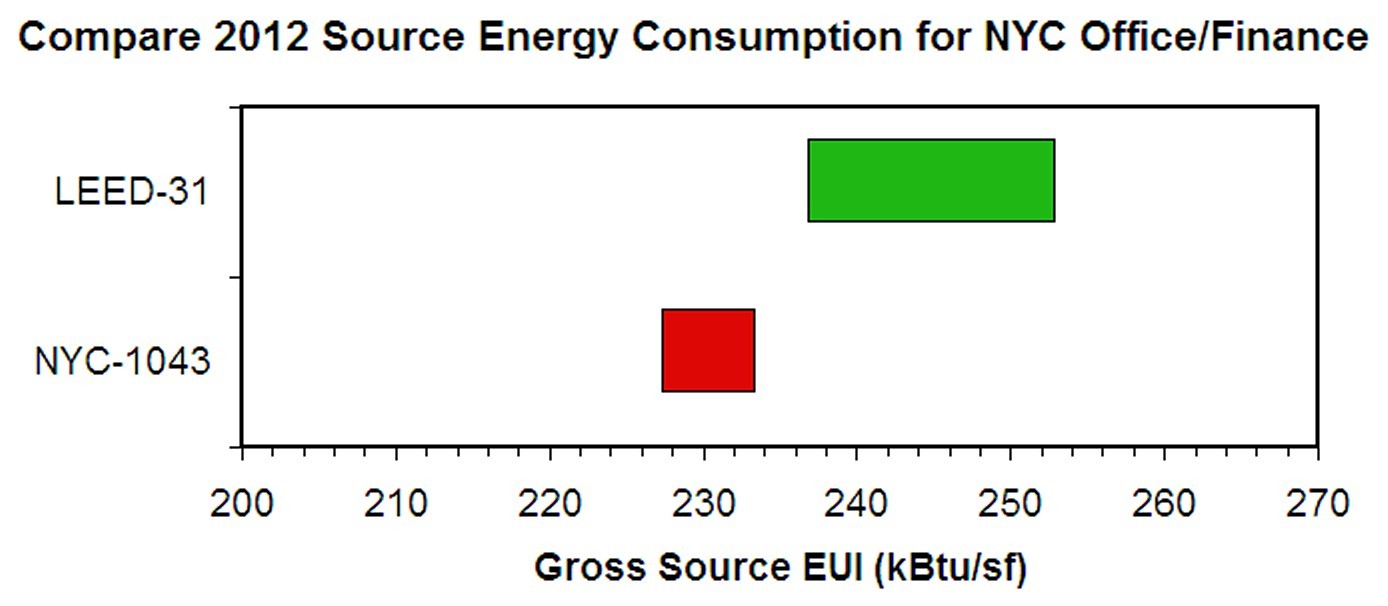
To determine whether these reductions are to be credited to the LEED buildings we need to look at similar numbers for conventional NYC office buildings.  The 2012 gross site and source EUI for the roughly 1,000 NYC office buildings are 92 and 230 kBtu/sf, respectively.  Comparing these to the energy data for the LEED offices we see that in 2012 LEED buildings used 7% more site energy and 6% more source energy than did conventional office buildings (on a per sf basis, of course).  Comparing their gross GHG intensities for 2012 we see that the 32 LEED certified office buildings are responsible for 8% more GHG emissions than conventional NYC office buildings.  The source EUI for the two building sets are compared in the figure below.

Compare LEED31 with NYC1043 Source

Bottom line, for the second year in a row LEED-certified NYC office buildings show no energy or GHG savings as compared with other NYC office buildings.  In fact they use more energy and emit more GHG than other NYC office buildings (on a per sf basis, of course).  These differences are more statistically significant than those between the LEED 2012 and 2011 performances — but need to be nailed down with further calculations.

When you compare the 2012 energy and GHG performance of all NYC office buildings with their performances in 2011 we an average decrease in Site EUI, Source EUI, and GHG emission of 11%, 10%, and 8% respectively.  In other words, the 2012 improvement in LEED performance simply tracks that for other NYC office buildings.  As they say, “all boats rise with the tide” — or in this case, go down with the tide.

The good news out of the 2012 Energy Benchmarking data is that all NYC office buildings made progress in lowering their GHG emission.  This is likely associated with the steady replacement of coal with natural gas at electric generating plants.  The abundance of natural gas released by fracking is most definitely lowering the carbon content of NYC’s electric supply.  A recent article by Alexis Madrigal describes greater advances yet to come in this area.

There is one more interesting fact about LEED office buildings included in the 2012 NYC benchmarking data.  Five of the 21 LEED office buildings who reported 2011 benchmarking data (the basis for my earlier study) are noticeably missing in the 2012 public benchmarking disclosure.  That means that these five building owners either 1) elected to pay the modest fine to NYC for failure to comply with LL84 or 2) have convinced the city to exempt them from mandatory benchmarking.  Either way this does not bode well for the future of energy transparency.  The USGBC has been collecting annual energy data for buildings certified under its v2009 and later yet publishes none of these data — only selected statistics as part of its marketing literature.  I think we all know what it means when someone invokes the “fifth amendment” and refuses to testify.  The same applies here to refusal to disclose energy data.  It is a good be that owners of really efficient buildings are not refusing to disclose their data.

I should also mention that Luke Rosiak of has published an article in the Washington Examiner regarding what the 2012 NYC Energy Benchmarking data have to say about the performance of LEED buildings as compared to other NYC buildings.  He focuses on Site EUI (rather than Source EUI) and also looks at the relationship between the number of LEED points awarded and Site EUI.  He finds negative correlation — in other words, the buildings that score higher LEED points tend to use relatively more site energy!

A special thanks to Oberlin College student Marisa Aikins for doing most of the work in cross-listing the NYC 2012 benchmarking data with the LEED project database.

The EPA doesn’t know the basis for its own ENERGY STAR building model

The US Environmental Protection Agency (EPA) issues ENERGY STAR building ratings for 11 different kinds of commercial buildings.  The so-called Technical Methodology for each of these building ratings is described in documents posted on the EPA web site.  Presumably anyone can work through the details of these technical documents to duplicate the EPA’s methodology.

But this is not the case for one of the models — that for Medical Office buildings.  If you follow the instructions set forth in the EPA’s document for extracting the building records from the 1999 CBECS on which this model is based you do not obtain the list of 82 buildings the EPA claims are the basis for this model.  Instead you obtain a list of 71 buildings.  Furthermore, if you calculate the mean properties of this set of 71 buildings you do not obtain those published by the EPA for this building set.  And finally, if you perform the regression the EPA says it has applied to these buildings you obtain different results than those published by the EPA.  In short, it is clear that the EPA’s Technical Methodology document for Medical Offices does not correctly describe their model.

I have petitioned the EPA through the Freedom of Information Act to supply the list of CBECS 1999 building ID’s that are used this model (EPA-HQ-2013-009270).   The EPA has responded that it does not have this list.  This means that the EPA not only has incorrectly described its own Medical Office model — it does not even know what the basis for this model is!  Its document describing the Technical Methodology for this model is fiction — just like the ENERGY STAR scores the EPA hands out for Medical Office buildings.

NYC Energy Benchmarking raises questions about LEED-certification

With growing concern over global climate change and the US Federal government frozen in political gridlock a number of U.S. cities have decided to unilaterally take action to reduce their own green house gas (GHG) emission.  Any serious effort to reduce GHG emission must involve the implementation of some kind of system to track energy consumption.  To this end these same cities have instituted Energy Benchmarking laws — laws that require building owners to annually submit energy consumption data (by fuel) to a designated agency that collects and processes these data.  The Institute for Market Transformation (IMT) has been instrumental in coordinating this effort.

The requirement is typically phased in over a couple of years — starting with municipal buildings, followed by large commercial buildings, smaller commercial buildings, and finally residential buildings.  New York City, Philadelphia, Washington DC, San Francisco, Austin, and Seattle were the first to pass such ordinances.  Minneapolis, Chicago, and Boston have all taken steps to follow suit.

Public disclosure of energy data is an important component of many (but not all) of these local ordinances.  New York City (NYC) is further along than other cities and last October released 2011 energy benchmarking data for commercial buildings that were 50,000 sf or larger — excluding condominiums.  Public benchmarking data were released for more than 4,000 large commercial buildings in the NYC’s five boroughs.  NYC, like many of the other cities engaged in benchmarking, utilized the EPA’s ENERGY STAR Portfolio Manager for gathering and processing benchmarking data.  Data released included building address, building type, total gsf, site energy intensity, weather-normalized source energy intensity, water usage, and total GHG emission.

The NYC benchmarking data included data for more than 1,000 office buildings.  Some of these buildings are certified green buildings, so would be expected to use less energy and have less GHG emission than other NYC office buildings.  These green buildings are not identified in the NYC Benchmarking data, but many may be identified by searching other data bases – such as the US Green Building Council’s LEED project database or the EPA’s list of ENERGY STAR certified buildings.

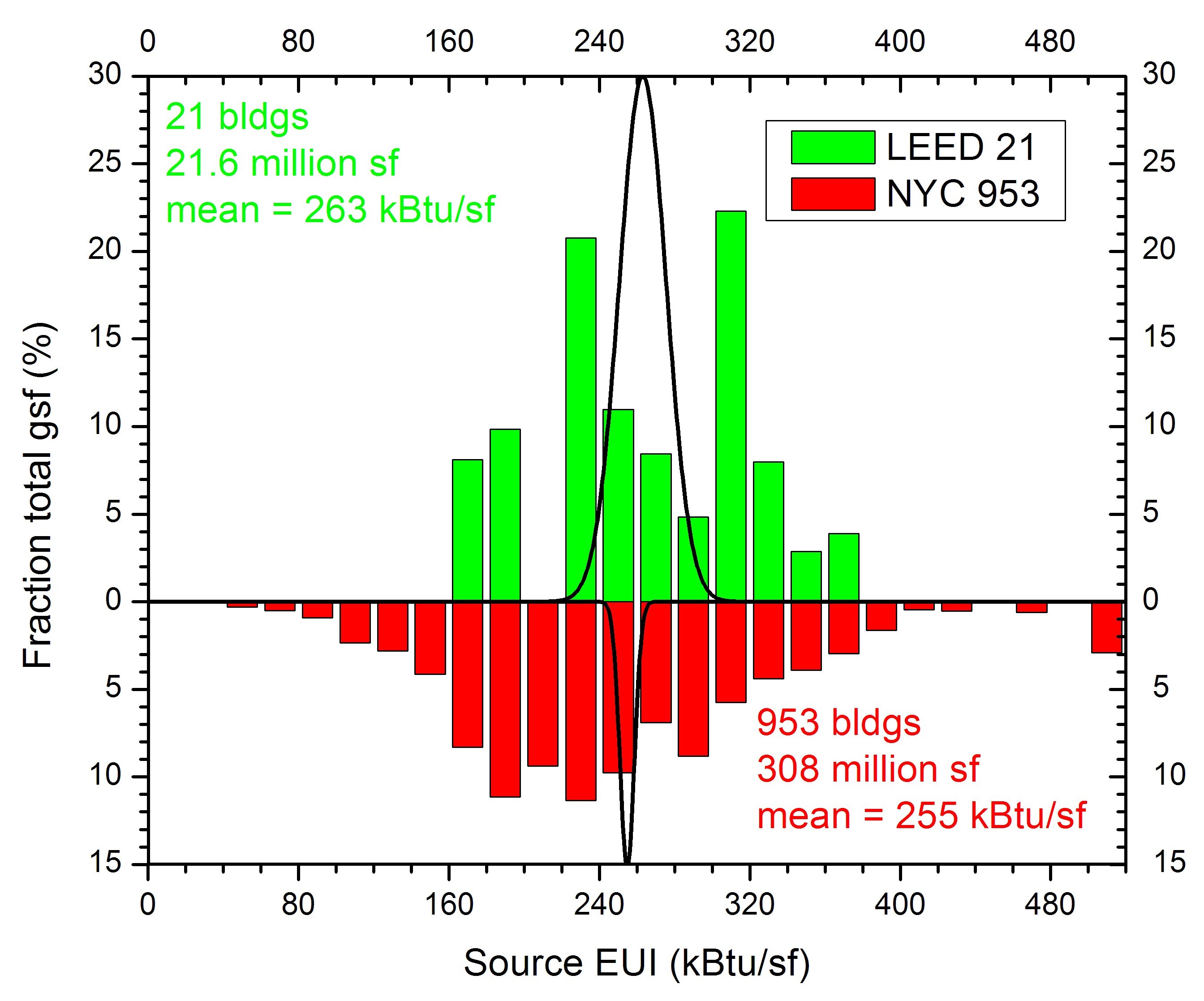
A few dozen LEED-certified office buildings have been identified in the 2011 NYC Benchmarking database.  (The full peer-reviewed paper is to be published in Energy and Buildings.)  Of these, 21 were certified before 2011 by new construction (NC), existing buildings operation and maintenance (EB:O&M), or core and shell (CS) LEED programs which address whole building energy use.  These 21 buildings constitute 21.6 million gsf.  Their 2011 source energy consumption and GHG emission has been compared with those for the other NYC office buildings with rather surprising results.  The LEED-certified office buildings, collectively are responsible for 3% more source energy consumption and GHG emission than other large NYC office buildings (adjusted for total gsf, of course).  The graph below compares source energy intensity histograms for the two building sets.

Source LEED-21 vs NYC 953pos

The graph shows that the difference in the mean source energy intensities of the two building sets is not statistically meaningful.  In other words, the source energy consumption and green house emission of these LEED-certified office buildings is no different from that of other NYC office buildings — no more and no less.

As of a few months ago there were something like 8,300 buildings certified under one of the LEED programs that claim to reduce whole building energy use.  Measured energy consumption data have been published for 3% of these (now about 250).  While many of these LEED buildings surely save energy, many do not.  Collectively the evidence suggests, that LEED certification does not produce any significant reduction in primary energy use or GHG emission.

Why then does the Federal Government — and other governments (including NYC) — require new government buildings to be LEED certified?   The Federal Drug Administration (FDA) would never certify a medical drug with so little scientific evidence offered — let alone require its use.  The standards here are inverted — apparently the Federal Government believes convincing scientific data must be offered to demonstrate that LEED-certified buildings do not save energy before they will change their policy.

Do Buildings that use Energy Star’s Portfolio Manager save energy?

The EPA regularly puts out press releases claiming the amount of energy that has been saved nationally by its Energy Star program.  In its October 2012 Data Trends publication entitled “Benchmarking and Energy Savings” the EPA writes the following:

Do buildings that consistently benchmark energy performance save energy? The answer is yes, based on the large number of buildings using the U.S. Environmental Protection Agency’s (EPA’s) ENERGY STAR Portfolio Manager to track and manage energy use.

After making this claim the EPA offers the following supporting evidence.

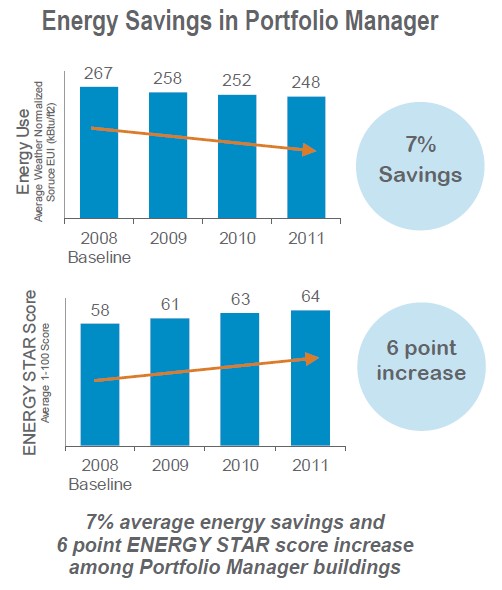
Over 35,000 buildings entered complete energy data in Portfolio Manager and received ENERGY STAR scores for 2008 through 2011, which represents three years of change from a 2008 baseline. These buildings realized savings every year, as measured by average weather-normalized energy use intensity and the ENERGY STAR score, which accounts for business activity. Their average annual savings is 2.4%, with a total savings of 7.0% and score increase of 6 points over the period of analysis.

What does this mean?  Does this mean that every one of the 35,000 buildings in question saw energy savings?  Impossible – over time some buildings saw their energy use go up and others saw it go down.  The statement clearly refers to an average result.  But what is being averaged?  The EPA is referring to the average (weather normalized) source energy intensity (EUI) for these 35,000 buildings — saying that it has decreased by 7% over three years  In addition it points out that the average Energy Star score for these buildings has increased by 6 points over three years.  The graphs below summarize these trends.

Data Trends

So here is the problem.  The average EUI for a set of N buildings has nothing to do with the total energy used by these buildings.  The average EUI could go down while the total energy use goes up and vise versa.  Some buildings see their EUI go up – and these buildings use more energy – and some see their EUI go down – and these buildings use less energy.  But you cannot determine whether more or less energy is used in total without calculating the actual energy saved or lost by each building – and this requires that you know more than the energy intensity (EUI) — you must also factor in each building’s size or gsf.  This set of 35,000 buildings includes buildings that are 5,000 sf in size and others that are 2,000,000 sf in size – a factor of 400 larger.  The EPA calculates mean EUI by treating every building equally.  But each building does not contribute equally to the total energy – bigger buildings use more energy.   (The EPA has employed the methodology used by the New Buildings Institute in their, now discredited, 2008 study of LEED buildings.)

It may be that these 35,000 buildings, in total, save energy.  But we don’t know and the EPA has offered no evidence to show that they do.  Moreover, I have asked the EPA to supply this evidence and they refuse to do so.  It is an easy calculation – but they choose not to share the result.  You can bet they have performed this calculation – why do you suppose they don’t share the result?

Now turn to the increased average Energy Star score.  There is actually no connection whatsoever between the average Energy Star score for a set of buildings and their total energy use.  For a single building, its Energy Star score, combined with its measured EUI and gsf allows you to calculate the energy it saved as compared with its predicted energy use.  Readers might be surprised to learn that a building’s Energy Star score can go up while its energy use rises as well.

But for a collection of buildings no such relationship exists.  If they are all one type of building (for instance, all dormitories) you can combine their individual scores with their individual gsf and their individual EUI to learn something about their total energy – but absent this additional information it is hopeless.  And if the buildings are from more than one building type there is absolutely no meaning to their average Energy Star Score.  Such statistics are intended only to impress the ignorant.

The EPA, therefore, has presented no evidence to support the claim that buildings that are regularly scored in Portfolio Manager collectively save energy.  Instead they have offered meaningless sound bites — claims that sound good but have no scientific relevance.

It is easy to see the problem by considering a simple case — two buildings – one a 100,000 sf office building and the other a 10,000 sf medical office.  Suppose in year 1 the office building has an EUI of 100 kBtu/sf and an Energy Star Score of 60, while in year 2 it has an EUI of 120 kBtu/sf and an Energy Star Score of 58.  Suppose that the medical office building in year 1 has an EUI and Energy Star score of 140 kBtu/sf and 50, respectively, and in the year 2 an EUI of 120 kBtu/sf and an Energy Star score of 60.

In this simple example the “average EUI” for year 1 is 120 kBtu/sf and for year two is 110 kBtu/sf – by the EPA’s standards, an 8% energy savings.  But when you work out the numbers you find their combined energy use in year two actually rose by 14%.  Surely EPA officials understand the difference.

To summarize, the EPA has claimed that the energy consumption of buildings that regularly use portfolio manager has gone down by 2.4% per year but they have offered no evidence to support this – only evidence that the average EUI for these 35,000 buildings – a meaningless figure, has gone down.

The EPA should either withdraw their claim or provide the evidence to back it up.

Energy Star scores for Medical Office Buildings exhibit “grade inflation”

This month I am beginning a series of articles to discuss the science (or lack thereof) behind the US Environmental Protection Agency’s building Energy Star benchmarking score.  Energy benchmarking has become very popular these days with eight or more major US cities having passed ordinances requiring commercial buildings to benchmark their energy data.  The EPA’s Energy Star Portfolio Manager is being used by all these cities for this effort.  In addition, both the US Green Building Council and Green Globes have adopted the building Energy Star score as the metric for energy efficiency success in their green building certification programs.

What is Benchmarking?

Benchmarking is a process by which you compare the energy used by your building with that used by other buildings in order to learn how you stand relative to “the pack.”  The energy used by your building is easily quantified by simply recording monthly energy purchases, combining data for twelve consecutive months to determine your annual energy consumption.  Anyone interested in lowering operating costs or improving the operation of a specific building might decide to to track their own annual energy consumption, comparing annual usage for successive years.  Simply comparing annual energy use for successive years of the same building can guide a building manager in making equipment and operational changes intended to improve energy efficiency.

But it is also useful to know how your energy use compares with energy used by other, similar buildings.  This is really what benchmarking is all about.  If you learn that your building uses much more energy than most other similar buildings – that would suggest there are some changes you can make to significantly lower your own energy consumption (and cost).  If, on the other hand, your building uses much less energy than most other buildings – then it probably does not make sense to invest a lot of time and energy in making further energy efficient improvements to your building.

the Commercial Building Energy Consumption Survey

So how do you find out how much energy other buildings use?  The basic tool for this is the Commercial Building Energy Consumption Survey (CBECS) usually conducted every 3-4 years by the Energy Information Administration (EIA).  The US commercial building stock consists of about 5 million buildings with 70 billion sf of floor space.  CBECS is designed to gather data from a small fraction of these buildings (about 6,000) specifically chosen to accurately represent the entire building stock.  In addition to recording size and annual energy purchases for these buildings the survey gathers numerous other pieces of information to characterize these buildings and how they are used.  Strict confidentiality is maintained for the 6,000 or so sampled buildings.  Nevertheless, sufficient data are gathered to perform queries on the data to learn average properties for various kinds of buildings broken down by climate region, function, size, age, and use.  The last CBECS to be performed was in 2003 and data for the next survey (2012) are to be released in 2014.

The Energy Star Building Score

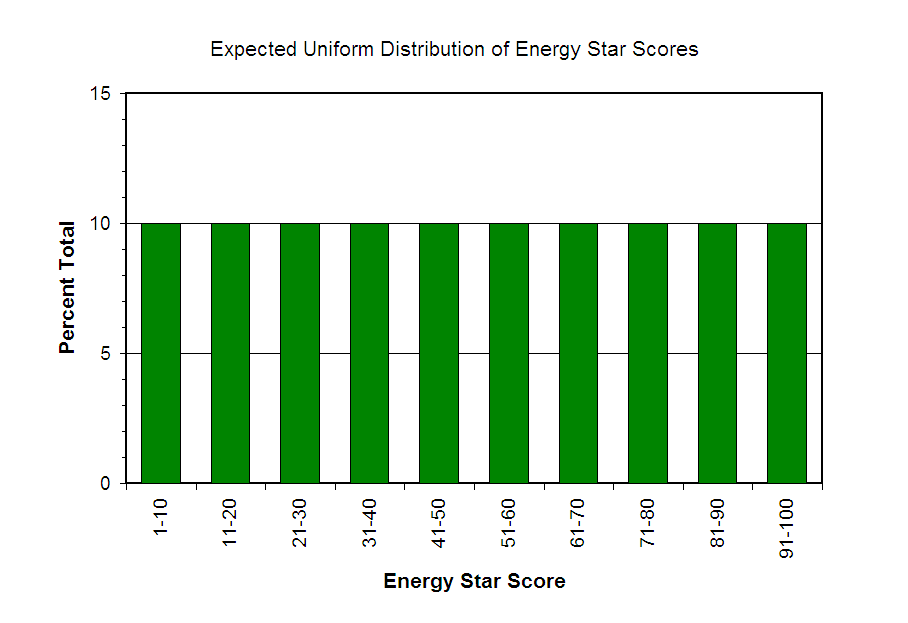
In 1999 the EPA first introduced its Energy Star building score for office buildings, the most common building type.  The score is a number ranging from 1-100 that is intended to represent a particular building’s percentile ranking with respect to energy consumption as compared with similar buildings nationally.  So, if your building receives a score of 75 that is supposed to mean that, if you were to look at all similar buildings across the country, your building uses less energy than 75% of them, adjusting for indicated operating conditions.  Office buildings are the most common type of building.  Presumably if it were possible to determine the Energy Star score for every office building in the country you would find that half of them have scores ranging from 1-50 and the rest from 51-100.  Similarly you expect 10% of office buildings to have scores ranging from 91-100 and another 10% would have scores from 1-10, etc.  In general, you would expect a histogram of Energy Star scores for all office buildings to look like this.

Uniform ES score distribution

The Problem with Energy Star Scores

In the last 8 years or so more and more building studies have published the Energy Star scores for fairly large sets of buildings.  For some reason the mean Energy Star scores for these buildings sets always seems to be greater than 50.  It is, of course, possible that, in each case, the buildings studied represented “better than average” buildings.  But it also raises the question – how do we know that the Energy Star scores for all US buildings are distributed as expected?  What evidence has the EPA ever offered to demonstrate the validity of these scores?  So far as I can tell the answer is none.  There are no peer-reviewed articles and no masters or Ph.D. theses describing these models and the numerous tests undertaken to demonstrate their validity.  All we have are rather short technical descriptions of algorithms used to define the models.  In fact, the EPA has known for years that the mean Energy Star score for all buildings whose data were entered into Portfolio Manager was 60 (now 62).  You would think they might want to investigate why?

One obvious way to test this is to conduct a random sample of a large number of US commercial buildings, use EPA algorithms to calculate their Energy Star scores, and see how these scores are distributed.  But the only such sample is CBECS!  When the 2012 CBECS data become available this will afford an excellent opportunity to conduct such a test – that should be sometime in 2014.  (Meanwhile, thousands of commercial buildings in major US cities are benchmarking their buildings using these Energy Star models.)  For many building types the CBECS 2003 data were the basis for the associated Energy Star model – this is the case for the current model for office buildings.  In these cases the 2003 CBECS data cannot provide independent confirmation of the Energy Star models.

But there are a few building types for which the Energy Star models are based on 1999 CBECS data.  One such building type is “Medical Office Buildings.”  In this case we can extract data for medical office buildings from CBECS 2003, calculate their Energy Star scores using the EPA’s model, then generate a histogram to show how these scores are distributed for all medical office buildings contained in the 2003 US commercial building stock.  The distribution is expected to be uniform as shown in the Figure above with some random uncertainty, or course.

I have done just that and the results are graphed below.  The graph clearly demonstrates that the scores are not uniformly distributed, and therefore the score cannot have the stated mathematical interpretation.  The mean Energy Star score is 65 well above the expected value of 50.  Nearly 45% of US medical office buildings have Energy Star scores from 81-100 – significantly higher than the expected 20%. and only 8% have scores ranging from 11-40, well below the expected 30%!  It is highly unlikely that US medical office buildings saw massive improvements in energy efficiency from 1999 to 2003.  The explanation is simpler — the model is based on faulty assumptions.

Medical Office 2003 ES histogram

This graph clearly calls into question the validity of the Energy Star Medical Office building model.  This model was developed in 2004 and has been in use for nearly a decade.  Is it possible that the EPA never conducted this simple test to check the validity of this model?   It would appear that for a decade now the EPA has employed a flawed building model to generate Energy Star scores for medical offices and to draw conclusions about the amount of energy the Energy Star program has saved.

If this one model is wrong — and the error went undetected so long — what confidence can we have in Energy Star models for other building types?

In my next issue I will look at the distribution of Energy Star scores for Dormitories/Residence Halls.

No evidence LEED building certification is saving primary energy

This essay is reproduced from the July 2013 issue of APS News.

Buildings are responsible for 39% of our nation’s energy consumption and associated green house gas (GHG) emission and they use 72% of the nation’s electricity [1].  It has long been established that cost-effective improvements in energy efficiency has great potential to reduce primary energy consumption and GHG emission associated with buildings.   The American Physical Society first took up this topic in 1974 [2].  A more recent APS study confirmed the potential remains [1].  Despite forty years of building technology research and public policy efforts to promote energy efficiency the energy efficiency potential for buildings remains largely untapped.

The Environmental Protection Agency (EPA) began promoting building energy efficiency in 1993 as part of its ENERGY STAR (ES) program, introducing its ES building score in 1999 [www.energystar.gov].  This score is based on measured energy consumption and is supposed to represent a building’s energy efficiency percentile ranking with respect to similar buildings in the U.S. commercial building stock.  A score of 75, required for ES Certification, implies that the building uses less primary energy than 75% of similar buildings under similar operating conditions nationally.

In 2000 the US Green Building Council (USGBC) introduced its Leadership in Energy and Environmental Design (LEED) green building rating system [www.usgbc.org].  Unlike ES, LEED certification was not based on measured energy performance but rather on “points achieved” through a checklist of items included in the building design and/or design process – all intended to make the building “green” or more energy efficient.  Four levels of certification are awarded depending on the total number of LEED points achieved – Certified, Silver, Gold, and Platinum.

LEED’s contribution was to marry the substance of energy efficiency with the popular appeal of green design.  It was a brilliant marketing strategy and, since its introduction, LEED certification has far surpassed ES certification in popularity.  Today nearly every large organization owns one or more LEED-certified buildings and many institutions – particularly governmental – have mandated that all their future buildings must be LEED certified at the silver level or higher.

But do LEED-certified buildings actually save primary energy and reduce GHG emission? LEED certification has clearly captured the public’s fancy – not unlike organic farming or herbal medicines.  But also like these fields there is a woeful lack of scientific data supporting LEED’s efficacy.  And what little measured building energy consumption data there are have been gathered through a “self-selected” process that is clearly biased towards the “better-performing” buildings.  In these data proponents find evidence that LEED-certification is saving energy [3].  But careful analysis of even these biased data show that LEED-certified buildings, with regard to primary (or source) energy consumption and GHG emission, perform like other buildings – no better and no worse [4].

First consider the amount and quality of energy consumption data published for LEED-certified buildings.  The vast majority of energy savings claims are not based on measured building energy performance but rather on design team projections.  LEED points for energy savings are based on these design projections – providing incentive for the design team to produce optimistic energy projections and to construct an inefficient “baseline” model to which these are compared.  Studies show there to be little correlation between design energy projections and subsequent measured energy performance [3, 4].  These design projections demonstrate intent not accomplishment.

There are, however, a dozen or so published studies containing measured energy consumption data for LEED-certified buildings.  These collectively provide energy data for, at most, 229 buildings – roughly 3% of the 8,309 LEED buildings certified before 2012.  Only four of these studies appear in peer-reviewed venues (two of these written by me) – the rest are reports written by or paid for by the USGBC or organizations closely aligned with it.  Buildings included in these studies are unlikely to be representative of the larger population.  Building owners control access to their energy data.  Nature – galaxies, rocks, atoms – doesn’t care what humans learn from their experiments.  Buildings do – or rather, their owners and design teams do – they have a vested interest in controlling energy data for the building for which they have already enjoyed extensive green publicity.  Owners are unlikely to voluntarily disclose embarrassing energy consumption data.  In a many cases requisite meters are not even installed – rendering the question moot.

The largest and most-widely publicized of these studies, conducted by the New Buildings Institute (NBI) in 2008 for the USGBC, concluded that “… average LEED energy use [is] 25-30% better than the national average” [3].  But the APS Energy Efficiency Study Committee concluded that the LEED buildings in the NBI study used more energy per square foot than the average for all existing commercial buildings [1].  NBI’s conclusion – similar to those published by other studies, is obtained by 1) a mathematical error in calculating the gross energy intensity for the LEED buildings, and 2) focusing on site energy – energy used at the buildings while ignoring off-site energy losses associated with electric generation and distribution.

First consider the mathematical error.  A building’s energy use intensity (EUI) is the ratio of its annual energy use to its gross square footage (gsf) or total floor area (surrogate for building volume).  EUI is convenient for comparing the energy use of two similar buildings differing only in size.  The Energy Information Agency (EIA) similarly defines the gross energy intensity of a set of N buildings to be their total energy divided by their total gsf – mathematically equivalent to the gsf-weighted mean EUI of the N buildings.  The EIA’s Commercial Building Energy Consumption Survey uses this metric to characterize the energy use of subsets of the national commercial building stock [5].  In the NBI study – indeed, in most LEED building studies – energy used by LEED sets of buildings are characterized by summing their individual EUI and dividing N.  This unweighted or “building-weighted” EUI is unrelated to the total energy used by the buildings.  When this error is corrected we find the LEED buildings in the NBI study use 10-15% less energy on site as compared with other buildings [4].

But energy used on site – called site energy – is only part of the story.  Site energy fails to account for the off-site losses incurred in producing the energy and delivering it to the building – particularly important for electric energy that, on average, is generated and distributed with 31% efficiency [1].  The EPA defines source energy to account for both on- and off-site energy consumption associated with a building; building ES scores are based on source energy consumption.  When you compare the source energy consumed by the LEED buildings in the NBI data set with that of comparable non-LEED buildings you find no difference – within the margin of error [4].

How do we understand these results?  First, LEED-certified buildings, similar to other new or renovated buildings are showing a modest reduction in energy used on site.  But these buildings are relying more on electric energy – and the off-site losses in the electric power sector are offsetting any savings in site energy.

The other issue is that larger buildings tend to have higher EUI than smaller buildings.  This may seem counter-intuitive since energy use in simple buildings (like houses) is dominated by surface losses/gains (windows, insulation, etc.).  But energy use in large commercial buildings is driven by internal loads – equipment, people, and lighting.  Large office buildings are typically air-conditioned year-round.  This is seen nationally as well as in LEED-certified buildings.  Roughly 5% of the nation’s commercial buildings account for half of the gsf of the building stock – and an even larger fraction of primary energy consumption [5].

In recognition of the need for actual performance data the USGBC has required all buildings certified under its 2009 version of LEED to measure and report annual energy consumption data to the USGBC for five years following certification.  And, for its Existing Buildings program – which targets renovated buildings – the USGBC has adopted the ES building rating system as its method for determining energy efficiency points – for the first time rewarding measured energy performance.

But these changes have not yielded convincing scientific data that demonstrate energy savings for LEED.  More than 2,400 buildings have been certified under LEED 2009 – with 711 of these certified before 2012.  Yet the USGBC has released no scientific report analyzing the energy data they have collected.  Instead they “cherry-pick” the data to create clever marketing sound bites that have no scientific value.  A USGBC press release last November claimed their data reveals that 195 LEED certified buildings received ES scores averaging 89 – demonstrating a 43% energy savings [6].  So what – presumably a million (of the 5 million) buildings in the commercial building stock have an “average” ES score of 89.  Scientists should not be impressed.  Moreover, while the source energy savings of a single building may be inferred from its ES score it is mathematically impossible to determine the energy savings for a collection of buildings from their average ES score (unless they all are identical in size and function) – hence the claim of 43% energy savings is unjustified.

These days the USGBC points to the high ES scores of its Existing Buildings program as evidence of energy savings for this program.  But the “value added” by LEED-certification is not established by comparing the certified building’s ES score to 50 – the presumed mean for all US buildings – it is found by comparing its ES score to those of similar, newly-renovated buildings that did not use the LEED process.  Any newly-renovated commercial building (LEED certified or otherwise) ought to see reduced energy consumption owing to cost-effective efficiency upgrades in lighting and heating, ventilation, and air-conditioning equipment.  Moreover, many of the buildings certified under the LEED Existing Buildings program have previously been certified by ES with scores significantly higher than 50.

The lack of energy consumption data for LEED and other commercial buildings is soon to change.  Six of our nation’s largest cities have passed ordinances requiring all commercial buildings to annually submit their energy consumption data into the ES system for subsequent municipal use.  New York City is the first such city, and last fall it made public 2011 energy consumption data for some 4,000 buildings of 50,000 sf or larger – and this list included nearly 1,000 office buildings of which 21 were identified as LEED certified.  These data clearly show there to be no statistically significant difference between the source energy consumed by or GHG emitted by LEED certified buildings as compared with other large NYC office buildings.  It should be noted that LEED office buildings certified at the Gold level and higher did outperform other office buildings.

At present there simply is no justification for governments mandating LEED building certification – using public dollars to subsidize a private enterprise with no scientific data to demonstrate efficacy in lowering primary energy consumption or GHG emission.  The problem is that LEED does not require public disclosure of energy consumption data and it does not have a mandatory energy performance requirement.  LEED certification clearly delivers green publicity but there is no evidence for primary energy savings, except possibly at the highest levels of certification (Gold and Platinum).  The USGBC could implement changes that would result in substantive savings – but this might negatively affect “sales of their product.”  We need to stop awarding buildings green publicity at the front end of a project and, instead, save the accolades for demonstrated reduction in GHG emission and primary energy use.

References

1.   Burton Richter et al. , “How America can look within to achieve energy security and reduce global warming,” Reviews of Modern Physics, Vol. 80, no. 4, S1 (Dec. 2008).

2.   Walter Carnahan et al., “Efficient Use of Energy,” American Physical Society, 1974.

3.   C. Turner and M. Frankel, 2008, “Energy Performance of LEED for New Construction Buildings – Final Report,” New Buildings Institute, White Salmon, WA.

4.   John H. Scofield, “Re-evaluation of the NBI LEED Energy Consumption Study,” Proceedings of the International Energy Program Evaluation Conference (IEPEC), Portland, OR, Aug. 12-15, 2009, pp. 765-777.

5.   See http://www.eia.gov/consumption/commercial/

6.   http://www.usgbc.org/articles/new-analysis-leed-buildings-are-top-11th-percentile-energy-performance-nation


DOE Launches Building Energy Database — but why?

The US DOE has announced the creation of a Building Performance Database (BPD) with energy data for some 60,000 residential and commercial buildings across the U.S.  Presumably data for more buildings will be added as it becomes available.

But what is the purpose of said database?  Data included are not gathered randomly nor with any schema that will guarantee they are representative of any particular class of buildings.  Essentially any data submitted to the database are included so long as the data satisfy some specified criteria and cover a period of 12-consecutive months.  For some buildings data might correspond to 2003 and for others 2012 — with no distinction.

I have energy data for an Oberlin College building for 12 consecutive years — with site EUI ranging from 30 to 55 kBtu/sf/yr.  For which year shall I submit the data?  The idea that energy consumption for a building is determined by one 12-month period is silly.  And what is the usefulness of a query to this database that returns energy data for buildings for different time periods?

What interesting questions can be answered by query to such a database?  In this case having incomplete information is actually worse than having no information.  If you have no information you at least understand the limitation.  But having some building energy data without any information regarding its context is worse — leads you to believe you know something when you don’t.