
Hotel at Oberlin — poster child for “Green Wash”

In May 2016 Oberlin College opened its newly constructed Hotel at Oberlin.  The New York Times ranked the Hotel third in its list of 5 Hotels and 5 Tours for the Eco-conciousTraveler.  It is all part of the ongoing marketing effort to paint Oberlin College as a sustainable and green institution.  Hard to believe that any amount of eco-spin can convince people that a view of Oberlin’s Tappan Square is  environmentally rewarding.

Of course what makes the Hotel at Oberlin a green destination is not it surroundings — it is the building itself.  Like the Taj Mahal, committed environmentalists will simply swoon in the presence of this green wonder.  The second (and larger) of Oberlin College’s highly-publicized green buildings, the College has claimed that the Hotel is the first 100% solar powered hotel in the world and one of only five Hotels in the world to win the coveted LEED Platinum rating.  In addition to claims of solar power the building is said to be heated by a geothermal well field and to include other green technologies — including radiant-cooled rooms.  Its web site boldly claims that it has achieved the LEED platinum rating.

Truth is the hotel is not powered by the sun nor is it LEED-certified at any level.

I  wrote about this Hotel nearly two years ago when it opened.  The main focus of that post was to address the solar claim.  I will not rehash the evidence here — please read the blog.  The claim is a brazen and clever lie — Donald Trump would admire its creativity!  Simply stated, the Hotel is no more solar powered than is my century-old home.  There is not one solar panel on the building site.  The 2.2 MW OSSO array that is claimed to power the Hotel was built years before the hotel, is located a mile away, and, by contract, sends all of its electricity to the City of Oberlin until 2037 at a price of $85/MWh.

Today I write to share the Hotel’s energy-performance data and to discuss its LEED rating.  The Hotel is well into its second year of operation and we now have 21 months of utility data.

In my 2016 post I suggested that the Hotel would use two million kWh annually, more than double the 800,000 kWh used by the Oberlin Inn it replaced.  For 2017 the Hotel actually used 1,400,000 kWh of electric energy.  This is 75% more electric energy than was used by the former Oberlin Inn, but less than my estimate.  It is consistent with the annual electric use projected for the Hotel by its design team.

But the Hotel also uses natural gas.  The marketing literature for the Hotel says that the building is heated with ground-source heat pumps.  Natural gas, we are told, is primarily for heating domestic water (laundry, showers, etc.) — available, but not anticipated for backup heat.  The design team projected the annual gas use to be 8,350 therms (Ccf).

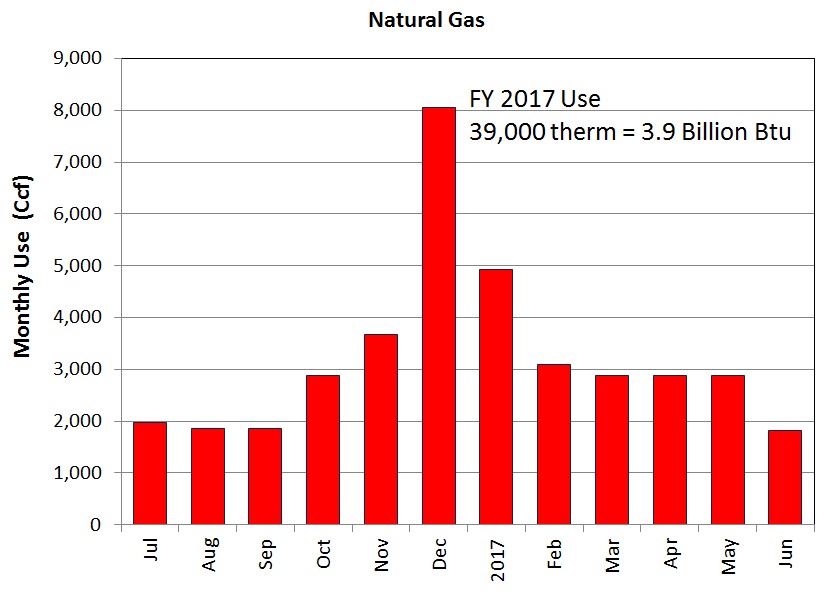
In fact, for 2017 the Hotel at Oberlin used 39,000 therms (Ccf), nearly 5X that predicted by the design team.  This is more natural gas than is used by any other Oberlin College building save one — the 130,000 sf Science Center!  The Science Center, constructed 17 years ago, contains numerous research and teaching laboratories and chemical hoods and has never been described as a green building.  It used 58,000 therm of natural gas in FY2017.  The natural gas use of the Hotel at Oberlin exceeds that of any other College building including the Firelands Dormitory (26,000 therm), the new Austin E. Knowlton complex (26,000 therms) and Stevenson Dining Hall (23,000 therms).

How does the Hotel at Oberlin’s energy performance compare with that of other hotels?  Consider its Energy Star score.  This can be estimated using the EPA’s Target Finder web site that allows quick data entry to estimate scores.  Entering the Hotel’s floor area (103,000 sf), number of guest rooms (70), cooking facility (Yes), 100% of the space heated and cooled, and actual FY2017 energy use, and accepting other default parameters, the Hotel at Oberlin is awarded an Energy Star score of 56.  According to the EPA — just a bit above average.  Don’t get me wrong — I am a huge critic of the Energy Star benchmarking score.  But it is one way to compare energy use with other hotels.

The monthly gas usage for the Hotel at Oberlin is shown below.  The excessive use in months Nov. – Feb. is clear evidence that significant gas is used for heating.  But even if you eliminate this heating use, the remaining use is nearly 3X the design estimate.
Finally, let me address the claim that the Hotel at Oberlin is certified LEED Platinum.  It simply is a lie.  I downloaded the USGBC LEED project database today.  The Hotel at Oberlin was registered on March 8, 2013 as “Confidential.”  Its LEED project ID is 1000031165.  As of today, February 23, 2017 the Hotel at Oberlin is not LEED-certified at any level.  The LEED project database says it has achieved 53 points — not enough to even achieve certification at even the Gold level.

Perhaps one day the claims being made for the Hotel at Oberlin will become true.  There is a lesson to be learned by looking at Oberlin’s Green building, generation-I, the Adam Joseph Lewis Center.

Oberlin College’s Adam Joseph Lewis Center  opened in 2000 to much acclaim.  Its proponents claimed it was a zero energy building (ZEB) for more than a decade when it just wasn’t true.  The claims were repeated by two Oberlin College presidents, College literature, and the College web site. The College never issued a retraction — it spent hundreds of thousands of dollars to correct flaws in the building’s HVAC design hoping to lower building energy use to a level that could be met by its 45 kW rooftop PV array.  The College eventually switched from “sticks” to “carrots” and in 2006, with the gift of a million dollars, built a second, 100 kW PV array over the adjacent parking lot and, with tripled electric production, renewed its ZEB claim for the building.  The building continued to use more energy than all of its arrays generated through 2011.  Even when faced with incontrovertible evidence that the claim was false the College continued to print the claim for another year in admissions literature distributed to students.  The College has never issued a public retraction or correction.  In 2012, after hiring a full-time building manager, the building finally used less energy that year than its PV arrays generated.  These arrays now feed two buildings, the AJLC and its adjacent annex.  Energy-intensive functions have been located in the annex and, collectively, these two buildings use more energy than the arrays produce.

Maybe in the next decade the College will build a parking garage next to the Hotel at Oberlin and put a huge PV array on it.  This could make the Hotel at Oberlin solar-powered — but not 100%.  Not sure how it will solve its natural gas problem — but clever minds will think of something.

The era of Donald Trump is here.  It is not illegal to lie, and no lie is too big to sell.

The bottom line is this.  The Hotel at Oberlin is just a normal, expensive hotel that purchases both electricity and natural gas from the local utility companies.  It uses more energy than the hotel it replaced.  It is the perfect symbol of modern green wash — 20 % substance, 60% exaggeration, 20% lies.

USGBC gives new meaning to Energy Star Score

This weekend I have been gathering data regarding LEED certified buildings made available at the Green Building Information Gateway.  In browsing through the web site I ran across a page that described Top Performing Buildings.  On that page I read this statement:

“One percent of buildings earned an Energy Star Score of 90+”

I don’t know if this statement is true or not — but I am humored by its implications.

According to the EPA, the building Energy Star score is a ranking of a building’s energy efficiency as compared with similar buildings in the U.S. commercial building stock.  It is assumed that the mean or median building score is 50 — simply reflecting the inescapable fact that half U.S. buildings are better than average and half are worse.  This is a necessary consequence of the meaning of a cumulative population distribution!

It also follows that 10% of the buildings necessarily have scores below 11 and 10% have scores higher than 90.

Perhaps it is true that only 1% receive scores that are 90 and higher.  But if true, the score clearly cannot reflect the meaning given it by the EPA.  Perhaps the author of that gbig web page needs to reflect on the meaning his/her/their statement.

NYC’s building energy grade discredits both Energy Star and LEED

I receive occasional newsletters from HVAC consultant Larry Spielvogel concerning building energy and the HVAC industry.  Yesterday he sent out a link to an editorial that appeared in Crains New York Business concerning a recent ordinance passed in New York City that “forces large buildings to post letter grades reflecting their energy use.”  These grades will apparently be based upon a building’s Energy Star score.

The Crains’ editor is aghast that a fine building like One World Trade Center which is LEED-gold certified, receives only a B grade.  Worse yet, the highly-acclaimed, LEED-platinum One Bryant Park building receives a C grade.  In closing the essay the editor writes, “Slapping a C next to a LEED Platinum rating will discredit both metrics, confuse the public and accomplish nothing.”

He is right on the first two counts but wrong on the third.  This will accomplish something very important, it will further the cause of truth!

It is better that the public be confused by the truth than to be told lies that bring clarity.  Confusion may lead to investigation and resolution.  The City’s new grade is based on the EPA’s building Energy Star score.  As I have shown in multiple venues, this score is largely garbage.  (See, for instance, earlier blogs from 2016-11-21, 2016-12-14, 2015-09-19, or 2014-08-22.)  The scoring system is mostly ad hoc, made up by non-engineers with a political agenda.  Armed with the knowledge acquired in a semester college statistics course they have developed scores that lack basis in building science or engineering .  They mean well — they want to help the environment.  Their approach is to condense building energy efficiency into a single metric that masses can understand and they can control.  But the score is largely meaningless and the DOE building scientists who helped develop the score 15 years ago have long since distanced themselves from this runaway system that lost its connection with reality.

LEED building certification, a system also born with good intentions, has been shown to have little average impact on building energy use!  LEED-certified office buildings in NYC use just as much energy as do other NYC office buildings.  Similar results have been uncovered in Chicago building energy benchmarking data.

The excessive energy used by One Bryant Park (aka The Bank of America Building) has been discussed before.  (See my earlier post and the New Republic article by Sam Roudman.)  For 2016, One Bryant Park had an annual site energy intensity of 211 kBtu/sf, more than twice that of the average NYC office building for 2015 (94 kBtu/sf). (For 2015 its energy use was somehow omitted from NYC’s public disclosure.)  The energy use of One World Trade Center (aka The Freedom Tower) has not appeared in the 2014, 2015, or 2016 NYC disclosures, despite the fact that the building opened in November 2014.  No doubt the Port Authority keeps its energy use secret as a matter of national security.

Nature does not care what awards these buildings have won or the clever technologies their owners have employed.  Nature only cares about total GHG emission and fossil fuel consumption and, by these measures, these buildings are not exemplary.

No doubt these building owners believe they are not responsible for the excessive energy use — it is their tenants.  True or not, it does not matter.  The building and its occupants are judged together.  If the owner is embarrassed — find different tenants.


Hot air emanating from the Windy City

This week Chicago mayor Rahm Emanuel hosted the North American Climate Summit attended by more than 50 mayors from major cities around the globe.  President Obama joined his old Chicago crony to address the summit.  Mayors joined together to sign the Chicago Climate Charter expressing their collective commitment to lower greenhouse gas emissions.

According to an article in HPAC Magazine Chicago Mayor Rahm Emanuel announced that Chicago had “reduced its carbon emissions by eleven percent from 2005 to 2015, bringing the city to forty percent of the way to meeting its Paris Climate
Agreement goals.”

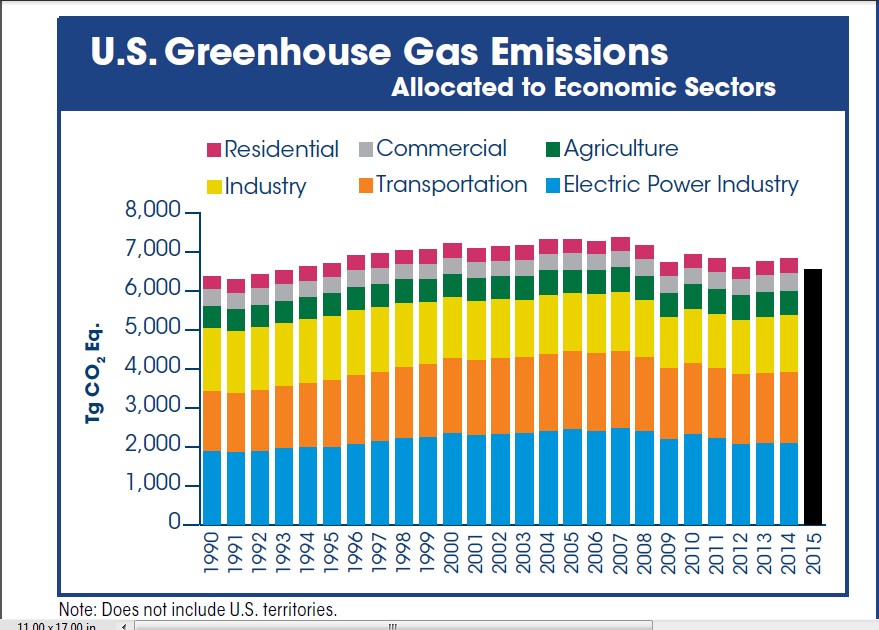
What bullshit!  The same claim can be made by essentially every city in the United States (some more, some less).  This reduction has nothing to do with any unique accomplishments in Chicago — it is due to the simple fact that GHG emissions for the entire US from 2005 to 2015 went down by 11%.  All boats rise with the tide or, in this case, recede.

The main reason for this national GHG reduction is the fact that over the last decade cheap, fracked natural gas has replaced vast amounts of coal in the electric power sector.  This single change is responsible for the majority of the reduction in US greenhouse gas emission this last decade.  It isn’t energy efficiency, green buildings, renewable energy, or conservation — it is the economic impact of cheap natural gas and the increased cost of coal power due to EPA regulations.

Below is a graph lifted from an EPA report showing total US GHG emissions from 1990 through 2014.  The last bar for 2015 (black) was added by me using data pulled from another article.  The blue bars in this graph shows emissions associated with the electric power sector.

Rahm Emanuel’s claim is true but meaningless — just a lot of hot air emanating from the Windy City.

Federal Government Brags about Being Average

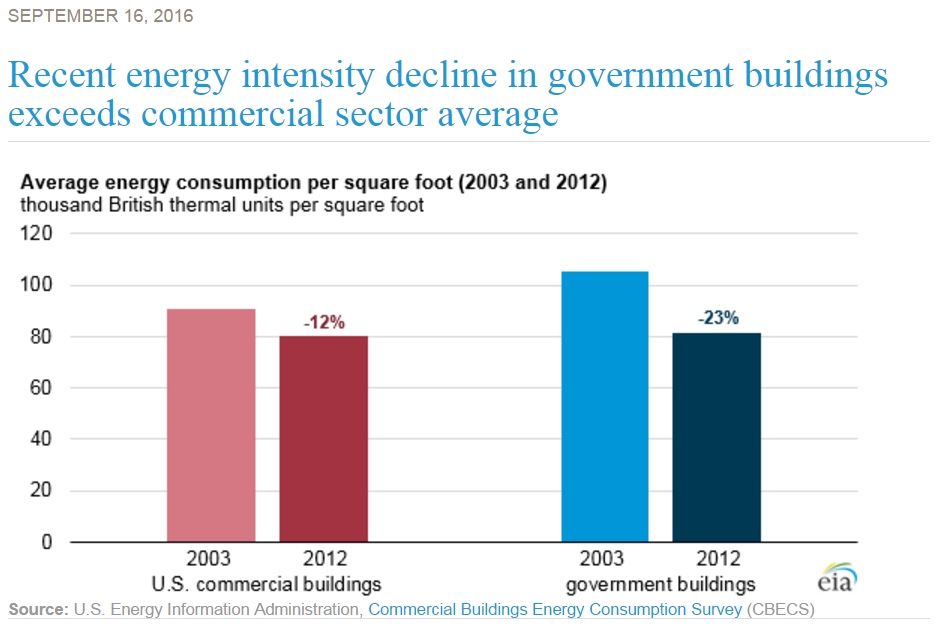
I recently ran across a post on the Energy Information Agency (EIA’s) web sit highlighting the fact that from 2003 to 2012 Federal buildings had achieved a greater decrease in energy use intensity than had been achieved by commercial buildings, on average. I find this spin to be offensive on various levels.

The relevant graph is shown below.

2016-09-16-government-building-eui

The first thing to note is that, even with this decrease in energy use Federal buildings still have higher EUI than do other commercial buildings (compare the red and blue 2012 bars).

Second, while I am pleased that the Federal government is learning how to operate its buildings almost as well as the rest of the commercial building sector, it is not a remarkable accomplishment.  It reminds me of a verbal exchange between then Governor Bill Clinton and businessman Ross Perot during a presidential debate.  Clinton was bragging that under his leadership the State of Arkansas had improved its rank among other states in education from almost last up to the middle of the pack.  Ross Perot pointed out that you don’t have to be innovative when you are ranked last — you will move up by just copying what others have done.  (I will confess, this is my memory of what happened, but it might be that I imagined this exchange — it is a good story, in any case.)

Third, why is the EIA engaging in such spin?  This agency is supposed to gather and disseminate energy facts.  Spin should be left to political parties.


The Illusions of EUI in Calculating Energy Savings

In the last month I have found the time to begin looking at the 2012 CBECS data released by the EIA last May.

Today I am writing about something I just learned concerning U.S. Worship Facilities.  Here I am looking at the subset of Worship Facilities that meet the criteria stated by the EPA for performing their multivariate regression for the Worship Facility ENERGY STAR model (about 80% of all U.S. Worship Facilities).

In comparing the 2012 and the 2003 CBECS data for Worship Facilities we see there was an estimated 2% increase in the number of these buildings.  As there is an 8-9% uncertainty in the estimated number of these facilities, this increase is  not statistically significant.  The EIA data show that the mean site energy use intensity (EUI) for these facilities actually went down by 15% from 48 to 41 kBtu/sf — and this reduction is statistically significant as it exceeds the 6-8% uncertainty in these figures.  No doubt some government agency will use this reduction to claim success in programs to promote energy efficiency.

But nature is not impressed because total energy used by these buildings actually went up.  The reason — the buildings are, on average, getting bigger!  From 2003 to 2012 the total gross square footage contained in this filtered subset of Worship Facilities increased from 3.2 to 3.8 billion sf, a whopping 23%.  Thus the total site energy used by Worship Facilities grew by 5%.  A similar conclusion can be made for source energy, even with the improved efficiency of the electric power sector over this last decade.

It should be noted that statistics show that the number of Americans who actually go to church declined by about 7% from 2007-2014.  So in a decade when religious worship is decreasing the amount of energy used by Worship Facilities has grown by about 5%.

Bottom line — don’t be fooled by decreases in building EUI.  It is total energy that matters.

New CBECS Data confirm EPA’s K-12 School ENERGY STAR score is nonsense

As I have written before — indeed, the subject of my recent book — my work shows that the EPA’s ENERGY STAR benchmarking scores for most building types are little more than placebos.  The signature feature of the ENERGY STAR benchmarking scores is the assumption that the EPA can adjust for external factors that impact building energy use.  This adjustment is based on linear regression performed on a relatively small dataset.  For most building types this regression dataset was extracted from the Energy Information Administration’s 2003 Commercial Building Energy Consumption Survey (CBECS).  The EPA has never demonstrated that these regressions accurately predict a component of the energy use of the larger building stock.  They simply perform their regression and assume it is accurate in predicting EUI for other similar buidings.

In the last three years I have challenged this assumption by testing whether the EPA regression accurately predicts energy use for buildings in a second, equivalent dataset taken from the earlier, 1999 CBECS.  In general I find these predictions to be invalid.    For one type of building — Supermarkets/Grocery Stores — I find the EPA’s predictions to be no better than those of randomly generated numbers!

In May of this year the EIA released public data for its 2012 Commercial Building Energy Consumption Survey.  These new data provide yet another opportunity to test the EPA’s predictions for nine different kinds of of buildings.  These new data will either validate the EPA’s regression models or confirm my earlier conclusion that they are invalid. Over the next year I will be extracting 2012 CBECS data to again test the nine ENERGY STAR benchmarking models based on CBECS data.

This week I performed the first of these tests for K-12 Schools.  539 records were extracted from the CBECS 2012 data for K-12 Schools representing 230,000 schools totalling 9.2 billion gsf.  After filtering these records based on EPA criteria, 431 records remain, representing a total of 137,000 schools with 8.0 billion gsf.

I performed the EPA’s weighted regression for K-12 Schools on this final dataset and obtained result totally inconsistent with those obtained by the EPA using CBEC 2003 data. Only 3 of the 11 variables identified by the EPA as “significant predictors” of building Source EUI for K-12 Schools demonstrated statistical significance with the 2012 data. Numerous other comparisons confirmed that the EPA’s regression demonstrated no validity with this new dataset.

The EPA will no doubt suggest that their model was valid for the 2003 building stock, but not for the 2012 stock — because the stock has changed so much in the intervening 9 years! While this seems plausible, this explanation does not hold water.  First, CBECS 2012 data do not suggest significant change in either the size or energy use of the K-12 School stock.  Moreover, this explanation cannot also explain why the EPA regression was not valid for the 1999 building stock — unless the EPA is to suggest that the stock changes so much in just 4 years to render the regression invalid.  And if that is the EPA position — then why would they even attempt to roll out new ENERGY STAR regression models for K-12 Schools based on 2012 CBECS data more than 4 years after these data were valid?  You can’t have it both ways.  Either the stock changes rather slowly and a 4 year delay is not important or this benchmarking methodology is doomed to be irrelevant from the start.


The more plausible explanation — supported by my study — is that the EPA’s regression is simply based on insufficient data and is not valid — even for the 2003 building stock.  I suggest a regression on a second, equivalent sample from the 2003 stock would yield results that differ from the EPA”s origina regression.  The EPA’s ENERGY STAR scores have not more validity than sugar pills.


NYC Energy Benchmarking Report Over-estimates Energy Savings

The Mayor’s Office in New York City has recently released their annual report looking at the 2013 energy data for commercial buildings.  This is the fourth such report.  Each annual report appears to take longer and longer to prepare suggesting it is easier to gather energy data than to analyze and understand it.

The lead line in this report is that those preparing the report conclude that over a four-year period (2010-2013) green house gases associated with NYC building energy has decreased by 8% and energy use by buildings has decreased by 6%.  They cannot resist suggesting that NYC’s energy benchmarking program can take credit for this reduction.

My analysis of these data show the savings is only half this amount. The other half of the claimed savings is an artifact of the EPA’s having lowered its national, site-to-source energy conversion factor for electricity in Summer 2013.  The same mistake was made by the Washington DC Department of the Environment a year ago.

NYC does not live in a vacuum.  Over the last 10 years expanded use of natural gas and retirement of coal plants has cleaned up the entire U.S. electric grid — of which NYC is a part.  In fact, the purchase of fracked natural gas from Pennsylvania (fracking is outlawed in NY State) is the primary driver of reduced green house gas emission in NYC.  It has little to do with NYC building policies!

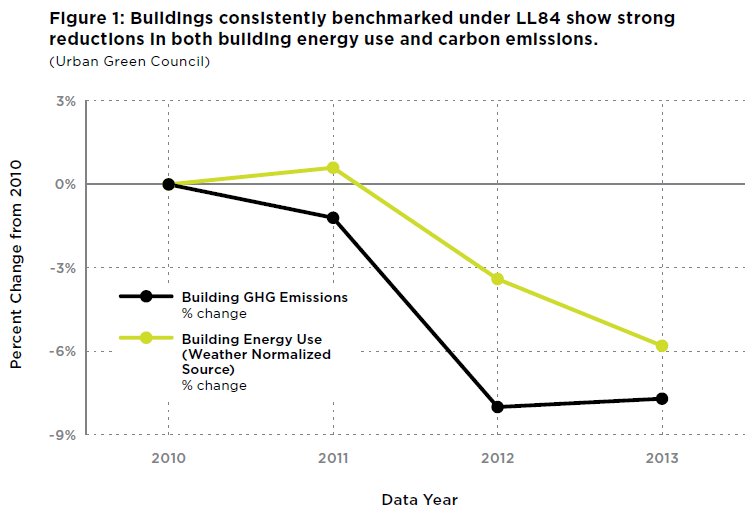
The NYC analysis apparently comes from adding up the annual greenhouse gas emission and weatherized source energy use of some 3,000 properties that submitted benchmarking data for all four years.  Using 2010 figures as a baseline the relative annual reductions for these selected properties are graphed below.

report figure 1

Here I want to focus on the source energy curve.  As compared with 2010, energy use went up slightly in 2011, then dropped by nearly 4% in 2012 and another 2.5% in 2013.  The drop in 2012 is easy to understand — hurricane Sandy brought the City to a grinding halt affecting tourism and many operations.  This reduction in energy use should be viewed with great skepticism.  But the continued reduction into 2013 seems like a sign of increased energy efficiency.  Or does it?

Until 2013 the EPA used a site-to-source energy conversion factor for electric energy of 3.34.  In summer 2013 the EPA adjusted this number by 6% to 3.14.  When it generated the 2013 report for NYC it used this reduced site-to-source energy conversion factor.  In other words, the 2013 reduction in NYC’s weather normalized source energy has little to do with building operation and everything to do with the EPA adjusting source energy down for the entire nation!  And this reduction does not reflect the single year improvement in the electric grid.  The EPA made no adjustment to this factor for many years prior to 2013, then in 2013 made a one-time-adjustment to reflect a 5-year average.

The NYC report is based on confidential data — no public benchmarking data were released for 2010.  Nevertheless, I can mimic the analysis by looking only at public NYC benchmarking data for 2011, 2012, and 2013.  In these data I find about 1200 buildings that reported energy data for each of these three years. About 1000 buildings remain after removing any that have questionable data for any of these three years (i.e., site EUI >1000 or <10 kBtu/sf).  The total weather normalized source energy for these buildings is graphed in blue below for each of the three years.  This graph mirrors the trend displayed in the NYC report.  The total site energy for these buildings is graphed in red.  The change in site energy matches the change in source energy for 2012 but not for 2013.  This confirms what I have explained above — that the EPA’s changing site-to-source energy conversion factor for 2013 is responsible for most of the change.  The graph below shows that 2013 site energy was actually higher than 2012 site energy.  It did not go down at all.

relative-energy-savings-scofield

The simple fact is that over the three year period shown below the site energy use of these 1000 buildings went down by only 3.5% — a figure which is highly uncertain given the sample size.  The 6% energy savings claimed by the Mayor’s Office is obtained through faulty analysis.


Energy harvesting — the siren’s allure

My wife, Deborah Mills-Scofield monitors dozens of media outlets and forwards articles to me that might be of interest.  One recently came my way about an effort in Portland, ME to harvest hydroelectric energy from its water pipes.  A company, LucidEnergy, has developed turbines that can be installed for this purpose.  The basic idea is to capture free energy in municipal water pipes that would otherwise be wasted.

While I applaud such innovation and creativity, I find the effort is misplaced.  I predict these turbines, like solar panels of the 1970’s and green roofs of this last decade — will soon be removed and abandoned.  This kind of energy harvesting is a fool’s errand.

About a decade ago I learned about another energy harvesting project in Israel — to install piezo-electric tranducers in highways to capture energy from passing trucks.  As heavy vehicles passed over these tranducers the truck weight would cause the transducers to compress and produce electricity.  The promoters of this energy argued that normal road compression represented lost energy — their technology would capture energy that would otherwise be lost.  The installed transducers did, in fact, produce electricity.  But I am confident that careful analysis would show that this energy comes from slight increase in fuel consumption of the vehicles that pass over the transducers.  Highway rolling resistance is mostly due to compression of the tires, not the road surface!

I am not aware of any evidence that water passing through municipal pipes arrives at end destinations with excessive kinetic energy.  Therefore any energy harvested along the way is likely to have to be re-injected by pumps.

And the maintenance issues must be significant.  I envision a few years of testing at the end of which it will be concluded that the cost of maintaining these units far exceeds the value of the energy they generate.  And what about the maintenance of pipes which get plugged due to low flow velocity?

Nature has handed us sunlight, wind, and hydo energy.  Harvesting these abundant resources is proving to be a challenge.  Harvesting efforts should focus on these well-understood and low-maintenance options.

Humans clearly waste a terrific amount of energy.  And there are many different ways that this wasted energy might be harvested.  The problem is cost-effectiveness.


San Francisco PUC Building not so green

SFPUC photoThe San Francisco Public Utilities Commission Administration building, constructed in 2012, has been billed as the greenest office building in North America.  Yesterday the San Francisco Examiner published an article which suggests the declaration was a bit premature.   According to its author, Joshua Sabatini, the $202 million dollar, LEED Platinum building has not performed up to expectations.  The building included integrated photovoltaic panels and wind turbines — enough to provide 7% of the building’s energy (not sure if that is total energy or just electric energy).  The energy produced by the wind turbines was never metered and the wind turbines have already been decommissioned; the company that installed them has filed for bankruptcy.  While the PV panels are reported to have satisfactory performance the inverter room was over-heating, requiring the installation of an auxiliary cooling system.  We will have to take the SFPUC’s word for this result as nowhere can I locate specific information about the expected PV electric generation.  It is so much easier to control the story when you don’t share the facts.

But Sabatini’s article does not discuss the energy performance of this building which is also rather disappointing.  According to 2014 energy benchmarking data published by San Francisco for municipal buildings the 277,511 sf SFPUC building had a measured site EUI of 54 kBtu/sf, just 10% lower than the mean for SF office buildings (60 kBtu/sf).  This is hardly the 32% energy savings claimed on the sfwater.org web site.  Moreover, the source EUI for this building is 153 kBtu/sf, which is 10% higher than the mean for the other 38 municipal office buildings whose 2014 energy data were disclosed.  This “greenest office building in North America” uses 10% more primary energy than used for other municipal office buildings — most of them constructed many years ago.

In other words this LEED Platinum building, the greenest office building in North America, uses 10% more primary energy than its counterparts in the San Francisco municipal building stock.  Sounds like a real winner.

Previously in 2009 I found that LEED-certified office buildings demonstrated modest (about 10%) site energy savings but, owing to their greater reliance on electric energy, demonstrated no significant source energy savings.  The result for the SFPUC building is even worse.